
Quick Answer
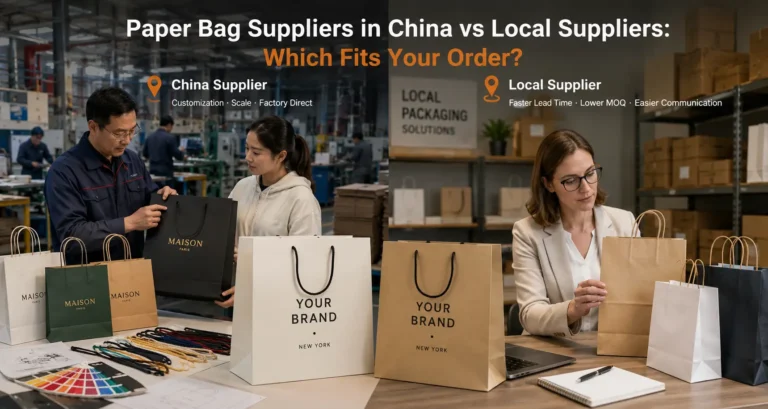
Choose between a paper bag supplier in China and a local supplier by comparing the same specifications, landed cost, MOQ, sample process, quality controls, delivery risk, and reorder needs. A China direct factory can suit custom or repeat production with enough planning time. A local supplier can suit urgent, simple, or low-inventory orders where speed and proximity matter more than customization depth.
Table of Contents
Key Takeaways: What Matters Most When Choosing a Paper Bag Supplier
- Compare identical paper bag specifications and delivery terms; unit prices alone do not show the true buying cost.
- A China direct factory is often more suitable for deeper customization, coordinated production, and planned repeat orders.
- A local supplier is often more suitable for urgent replenishment, standard bags, and projects that cannot absorb long-distance freight time.
- Approve physical samples and written quality criteria before bulk production, regardless of supplier location.
The right supplier is not determined by country alone. Two factories in the same region can differ in equipment, sampling support, quality controls, communication, and willingness to handle complex finishing. A local distributor may be fast but offer limited structural changes, while a direct factory may offer more customization but require earlier planning.
For a useful comparison, define the bag first: size, paper type and GSM, print coverage, handle structure, reinforcement, finish, quantity, sample requirement, packing method, destination, and delivery date. Then ask each supplier to quote the same brief.
China vs Local Paper Bag Suppliers: Fast Decision Table
| Buyer Condition | China Direct Factory | Local Supplier | Practical Decision |
|---|---|---|---|
| Custom size, printing, handles, reinforcement, or finishing | Often a stronger fit when the factory can confirm the required processes | May be limited to stocked structures or outsourced customization | Ask which processes are completed in-house and request a physical sample |
| Urgent delivery or unexpected stock shortage | Long-distance freight can make emergency replenishment impractical | Usually better positioned for short delivery windows | Choose local supply when missing the launch date is the largest risk |
| Repeat orders with stable artwork and specifications | Can become practical when approvals and reorder standards are documented | Useful when local storage, smaller releases, or quick replenishment matter | Compare annual landed cost and inventory pressure, not one purchase order |
| Very uncertain demand | MOQ and freight may create excess inventory | Stock bags or short runs may reduce commitment | Validate demand before investing in complex custom production |
| Several coordinated packaging components | A suitable factory may coordinate paper bags, boxes, tissue, tags, stickers, and cards | Convenient if all items are already stocked locally | Check color references, ownership, packing, and timing across every component |
Swipe horizontally to view the full table.
If you are still defining materials and finishes, review the available custom paper bag structures and printing options before sending the same brief to suppliers.
Not Sure Whether China Sourcing Makes Sense for Your Order? Send us your quantity, approximate bag size, destination, and required date. We can review whether direct-factory production is practical before you commit to detailed artwork or sampling.
- Whether direct-factory production fits the quantity and timing
- A practical sample and approval path for the bag specification
- The freight and delivery risks that should be considered early
This review is based on Originality Pack's 25+ years of packaging production experience, physical sampling support, factory-side quality checks, and coordinated paper bags, boxes, tissue, tags, stickers, and cards for overseas projects.
When a China Paper Bag Factory Is the Better Fit
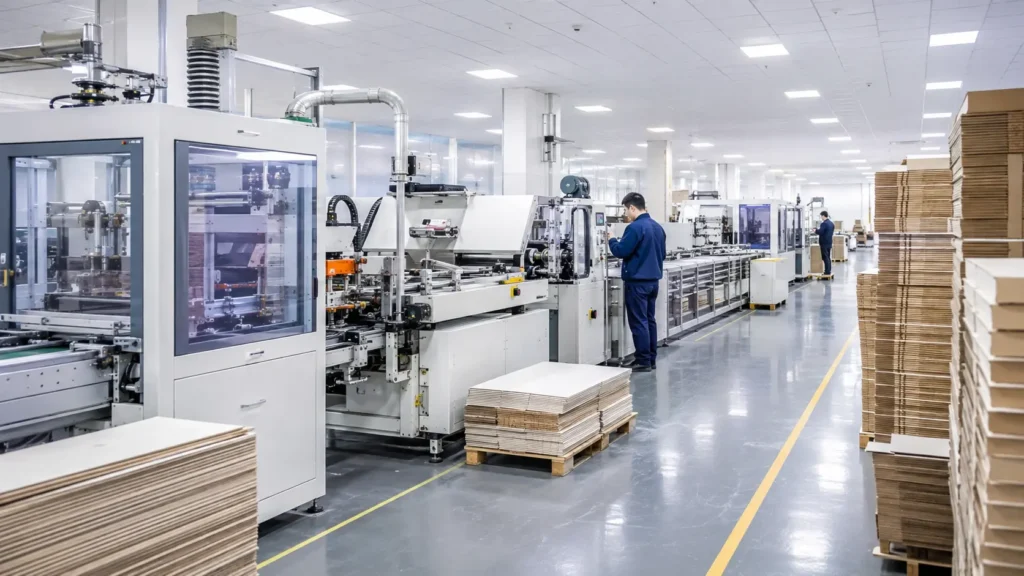
A China paper bag factory is more suitable when the order has stable specifications, meaningful customization, sufficient planning time, and a repeat-production opportunity. The buyer must still verify the actual factory, sample standard, production scope, and shipping responsibility.
Suitable when:
- Your bag requires a custom size, paper stock, handle, reinforcement, print method, or decorative finish.
- You can approve artwork and a physical sample before production.
- You can plan freight and inventory instead of ordering only after stock runs low.
- You need several packaging components produced under one coordinated specification.
- You expect repeat orders and can document the approved sample, color reference, packing method, and tolerances.
May not be suitable when:
- The bags must arrive urgently and there is no time for sampling, production, freight, and customs handling.
- Demand is untested and the required order would create uncomfortable inventory risk.
- You only need a standard unprinted bag already available from local stock.
When a Local Supplier Is the Better Fit
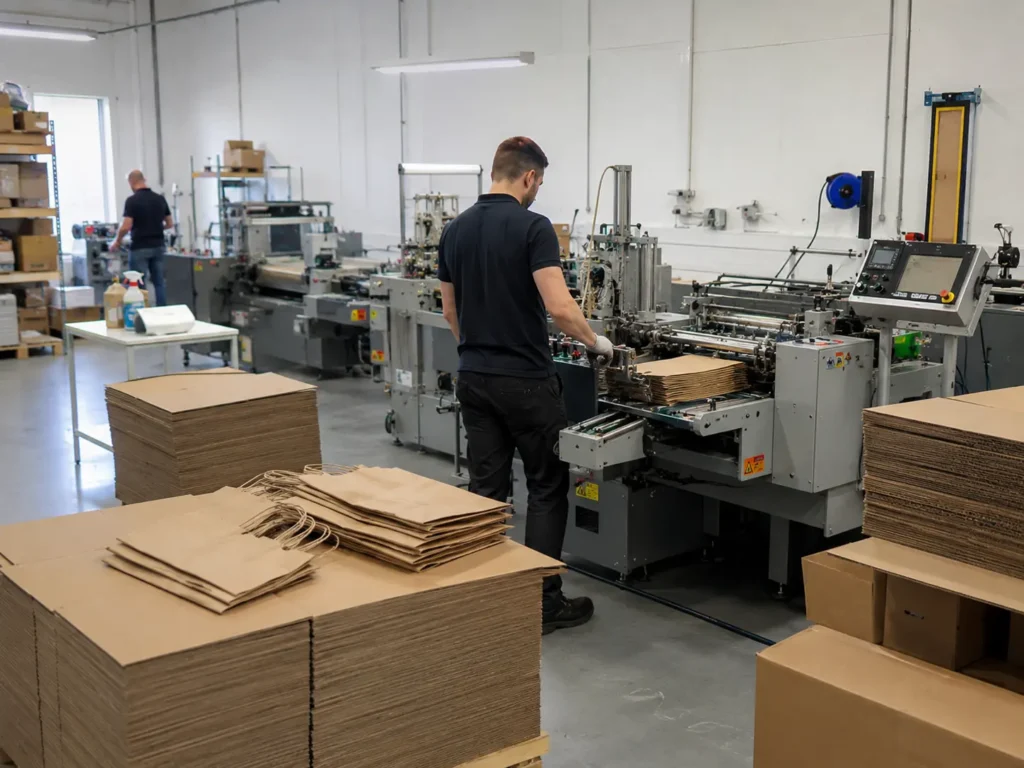
A local supplier is more suitable when speed, easy replenishment, or low inventory exposure is the priority. The trade-off may be less customization, fewer material choices, or a higher cost pressure for bespoke work.
Local sourcing can be especially useful for launch emergencies, seasonal tests, pop-up retail, or backup inventory. It can also simplify returns and communication. However, “local” does not automatically mean the supplier manufactures the bag locally. Ask whether it is a manufacturer, printer, distributor, or importer, and confirm which processes it controls.
Compare Landed Cost, Not Only Unit Price
The lower quoted unit price is not necessarily the lower buying cost. A fair comparison must use the same bag specifications, quantity, packing assumptions, delivery destination, and trade terms.
Landed cost = production + setup + packing + freight + duties and import fees + local delivery + expected waste + inventory carrying pressure.
For U.S. imports, Customs and Border Protection explains that duties, taxes, and user fees depend on the commodity, entry, and transport method. Buyers should confirm the applicable requirements for their shipment instead of assuming freight is the only additional cost. See the official CBP import fees guidance.
For U.S. orders, buyers should also confirm the HTS classification and whether the specific bag falls within the written scope of any applicable antidumping or countervailing duty order before calculating landed cost. The U.S. Department of Commerce published antidumping duty orders and countervailing duty orders covering certain paper shopping bags from China on July 18, 2024. The notices include product dimensions, material parameters, and exclusions, and state that their written scope—not the HTSUS code alone—is controlling. Importers should obtain project-specific classification and scope advice rather than applying a general rate assumption.
Also compare payment timing, sample charges, artwork changes, storage needs, and the cost of a missed delivery date. Do not use different Incoterms or packing quantities when comparing quotations; the totals will not be equivalent.
What to Check in Paper Bag Samples and Quality Control
A paper bag sample should be approved against its actual use, not only its appearance. Check the packed product weight, handle attachment, top fold, bottom reinforcement, paper stiffness, print position, finish registration, color reference, glue marks, and carton packing.
- Dimensions: Confirm width, gusset, and height using the same measurement method.
- Paper: Record paper type, GSM, surface, coating, and any approved material reference.
- Handles: Check material, length, color, hole position, knots or attachments, and reinforcement.
- Print and finish: Review small text, logo edges, foil or emboss registration, lamination, and areas prone to scratching.
- Use test: Pack the real product and test lifting, carrying, rubbing, and storage under realistic conditions.
- Bulk standard: Define acceptable tolerances and defect handling in writing before production.
Use the paper bag GSM and thickness guide to choose a practical starting point, but confirm stiffness and strength with the final size, handle, reinforcement, and packed product.
How MOQ, Lead Time, Freight, and Inventory Change the Choice
MOQ is only one part of order planning. A lower MOQ can reduce inventory exposure but increase cost pressure because setup and production preparation are spread across fewer bags. A larger order can improve production efficiency but tie up cash and storage space.
Request quotations at several realistic quantity levels rather than one artificial number. Compare how each level affects unit-cost pressure, carton count, freight method, storage, and reorder timing. The best tier is the one that matches expected use without creating avoidable stock.
Use our packaging order quantity calculator to establish a demand-based starting point before comparing supplier quantity tiers.
For a deeper explanation of these trade-offs, see the custom paper bag MOQ guide. If sourcing from China, separate sample time, production time, export packing, international freight, customs, and final delivery instead of treating them as one lead-time promise.
From Our Production Experience: Quantity and Timing Matter More Than Buyers Expect
What we often see: First-time buyers begin by asking for about 100 paper bags because the commitment feels safer.
Why the unit cost changes: Sampling, print preparation, setup, hand-finishing, and packing work still exist at that quantity. Moving from roughly 100 bags toward a few hundred may increase the total order value less sharply than the quantity increases, so the unit-cost pressure can fall significantly.
What buyers should do: Ask for several realistic quantity tiers instead of assuming the smallest order is the safest value. The practical break point depends on the bag size, material, printing, handles, finishing, and packing.
Very small paper bag orders are also difficult to optimize for ocean freight. Paper bags can occupy substantial carton volume relative to the order value, while courier or air freight may remove much of the apparent factory-price advantage. This is why a small custom order should be assessed as a complete delivered project, not only as a production price.
We also see buyers who expect to need around 1,000 bags but wait until the launch or stockout is too close. At that point, local production may feel expensive, normal freight from China may not arrive in time, and urgent air freight may create unacceptable cost pressure. The better approach is to approve the specification and sample early, then set a reorder point based on production, freight, customs, and safety-stock time.
What Material and Compliance Evidence Should You Verify?
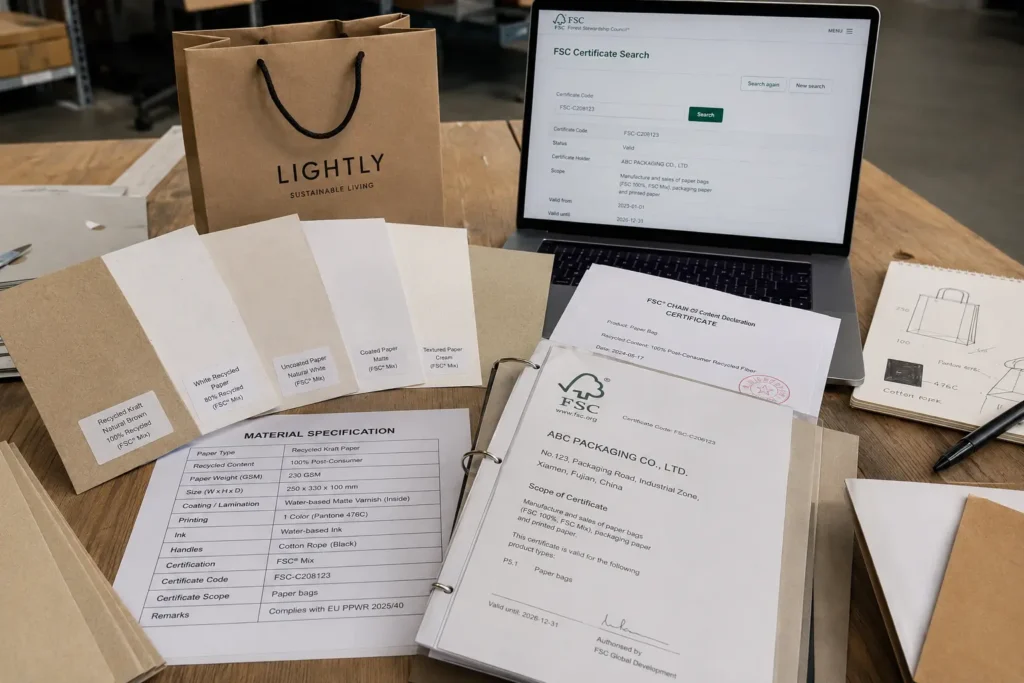
Do not accept “sustainable,” “recycled,” or “certified” as complete specifications. Ask for the exact paper description, recycled-content claim where relevant, coating or lamination details, ink requirements, certificate code, certificate scope, and any market-specific evidence required for your application.
The FSC certificate search allows buyers to check certificate validity and review the product types covered by a certificate. A company name or logo alone does not prove that the quoted paper bag and supply chain are included.
For buyers selling into the European Union, the European Commission states that Packaging and Packaging Waste Regulation 2025/40 generally applies from August 12, 2026 and covers packaging placed on the EU market regardless of material or origin. Confirm the requirements applicable to your exact product and market using the European Commission packaging-waste guidance.
Common Mistakes Brands Make When Comparing Suppliers
Comparing different specifications. One quote may use different paper, reinforcement, handles, printing, finishing, or carton packing. The prices are not comparable until the specifications match.
Choosing by country instead of capability. Location does not prove quality, speed, or reliability. Verify the supplier’s actual production role, sample process, QC records, communication, and responsibility for outsourced work.
Approving only a digital mockup. A screen cannot confirm paper stiffness, handle strength, finish registration, color on the chosen substrate, or how the bag performs with the real product.
Ignoring carton packing and shipping volume. Paper bags can occupy significant space. Final carton size and packing quantity can change freight and warehouse requirements.
Leaving trade terms unclear. Confirm what the price includes, where risk transfers, who handles customs, and which delivery point is covered before comparing totals.
Paper Bag RFQ Checklist for Comparable Quotes
A reliable paper bag quotation starts with a controlled brief. Send every supplier the same information and require them to list assumptions and exclusions.
| RFQ Item | What to Provide | Why It Matters |
|---|---|---|
| Use case | Product type, packed weight, retail or event use, and handling conditions | Determines paper, handles, reinforcement, and testing needs |
| Dimensions | Width × gusset × height and measurement method | Affects structure, paper use, carton size, and freight |
| Materials | Paper type, GSM, surface, coating, and certification requirement | Controls stiffness, print result, durability, and compliance evidence |
| Printing and finishing | Colors, coverage, Pantone references, lamination, foil, embossing, or spot effects | Changes process, sampling, setup, and production risk |
| Handle and reinforcement | Handle material, length, color, attachment, top fold, and bottom insert | Directly affects carrying performance |
| Quantity and reorders | Realistic quantity tiers and expected annual use | Helps balance production efficiency and inventory exposure |
| Delivery | Country, postal code, required date, shipping preference, and Incoterm | Makes landed-cost and timeline comparisons meaningful |
Swipe horizontally to view the full table.
For the wider overseas sourcing process—including specifications, samples, payment, QC, and shipping responsibility—use the custom packaging from China buyer checklist.
Why Originality Pack Fits Planned, Custom Paper Bag Projects
Originality Pack is a China-based packaging factory with more than 25 years of packaging production experience. For suitable projects, the team can coordinate paper bags with boxes, tissue paper, hang tags, stickers, and printed cards under one packaging plan instead of asking the buyer to manage each component separately.
The process can include physical sampling before bulk production, artwork and specification checks, and factory-side quality control for the approved paper bag. FSC paper options are available for suitable projects, but the required certificate, chain-of-custody scope, product claim, and market documentation must still be confirmed for the specific order. See the current Originality Pack custom paper bag capabilities.
This approach fits buyers who need custom structures, repeat-production control, or coordinated packaging components and have enough time to complete approvals properly. Final material availability, MOQ, sample type, finishing capability, production schedule, certification scope, and shipping plan remain project-specific.
Frequently Asked Questions Before Choosing a Paper Bag Supplier
No. The result depends on specifications, quantity, setup, packing, freight, duties, storage, and waste. Compare landed cost using identical specifications and delivery terms.
Choose local supply when urgent delivery, easy replenishment, standard products, or low inventory exposure matters more than deep customization. Confirm whether the supplier manufactures locally or imports and resells the bags.
Provide the use case, dimensions, quantity, paper and GSM, printing, finishing, handle, reinforcement, artwork status, sample needs, delivery location, required date, and Incoterm.
Approve a physical sample and document dimensions, paper, color reference, print position, finishes, handle attachment, reinforcement, packed-product performance, tolerances, and defect handling.
Some packaging factories can coordinate several components, but confirm the actual production scope and any outsourced processes. Use shared color references and a coordinated approval schedule, because paper, fabric, adhesive, and printing processes can reproduce color differently.
Final Recommendation: Choose by Project Conditions, Not Country Alone
Choose a China direct factory when customization, coordinated production, and repeat-order planning justify the longer supply chain. Choose a local supplier when speed, standard stock, or low inventory exposure is the priority. In both cases, control the result with identical specifications, physical samples, written quality criteria, and a complete landed-cost comparison.
Ready to move forward with a paper bag project? Share the approximate size, packed product, quantity, artwork status, material or finish preferences, destination, and required date. We can review the project before the order moves into detailed artwork, sampling, or production planning.
- Bag specifications, materials, finishes, handles, and coordinated packaging components
- Sampling and factory-side quality-control assumptions
- Production timing, shipping options, and delivery planning
Originality Pack can coordinate paper bags with boxes, tissue paper, hang tags, stickers, and printed cards, so suitable projects can be reviewed as one packaging system rather than as separate supplier tasks.
Verify These Sources Before Finalizing Material and Import Requirements
- U.S. Customs and Border Protection: Duty, Taxes and Other Fees Required to Import Goods into the United States
- U.S. Department of Commerce: Certain Paper Shopping Bags Antidumping Duty Orders, published July 18, 2024
- U.S. Department of Commerce: Certain Paper Shopping Bags from China and India Countervailing Duty Orders, published July 18, 2024
- Forest Stewardship Council: FSC Certificate Search and Certificate Scope Guidance
- European Commission: Packaging Waste and Packaging and Packaging Waste Regulation