

Quick Answer
To calculate how much custom packaging to order, estimate packaging use during the supplier’s total lead time and your chosen coverage period, add safety stock and non-sales use, then subtract usable stock and confirmed inbound inventory. Compare that result with the supplier’s MOQ, but do not automatically overbuy: cash flow, storage, design stability, and demand confidence can make a smaller or less customized first run safer.
Table of Contents
What Should You Decide Before Placing a Custom Packaging Order?
- Calculate demand before comparing price breaks. A lower unit price does not help if part of the order becomes unusable.
- Treat MOQ as a production constraint, not a demand forecast. Your supplier’s minimum and your safe inventory quantity answer different questions.
- Calculate a reorder point separately. Order quantity determines how much arrives; the reorder point determines when to place the next order.
- Shorten the commitment when uncertainty is high. New SKUs, seasonal artwork, regulatory changes, and rebrands increase obsolete-inventory risk.
How Much Custom Packaging Should You Order? Start With This Formula
Calculate the stock you need from today through the next delivery, then add the amount you want available after that delivery. This avoids a common planning mistake: choosing a three-month order while forgetting that production and shipping may already consume part of those three months.
Calculate Average Daily Packaging Use
This gives you the average number of packaging units used per day before seasonal, promotional, or other expected demand adjustments.
Calculate the Baseline Order Requirement
The result estimates how much packaging you need to cover replenishment lead time, your target inventory period after delivery, and an appropriate safety buffer.
Before You Calculate
Use This Custom Packaging Order Quantity Calculator
The calculator gives you a baseline requirement, an MOQ-adjusted comparison, and a reorder point. The MOQ-adjusted result is not an automatic recommendation. If the supplier minimum is materially higher than your calculated need, review the warning before approving the order.
Not sure whether your calculated quantity makes sense for production? Send the essentials below for a practical first check.
- Packaging type and dimensions
- Calculated quantity and artwork status
- Delivery country
Originality Pack can compare practical quantity tiers and check which specifications may change the MOQ before preparing a project-specific quote.
Factory Experience
Originality Pack has more than 25 years of packaging manufacturing experience with custom paper bags, folding and rigid paper boxes, and corrugated mailer boxes. Depending on the product and specification, the team can review lower-MOQ routes, physical sampling before mass production, and delivery planning for overseas orders.
- Quantity check: Compare expected use with several realistic production tiers.
- Specification check: Review size, material, print method, finish, artwork versions, and carton packing because each can change MOQ or storage volume.
- Risk check: Confirm what a sample must prove and which assumptions remain project-specific before bulk production.
Calculator limitation: This is a planning tool, not an ERP forecast or supplier quotation. Run at least a normal-demand scenario and a peak-demand scenario. If demand is intermittent, highly promotional, or strongly seasonal, a simple average can hide risk. Oracle’s inventory documentation makes the same limitation explicit for statistical safety-stock calculations (Oracle NetSuite).
When Is Ordering Above the MOQ Worth the Lower Unit Cost?
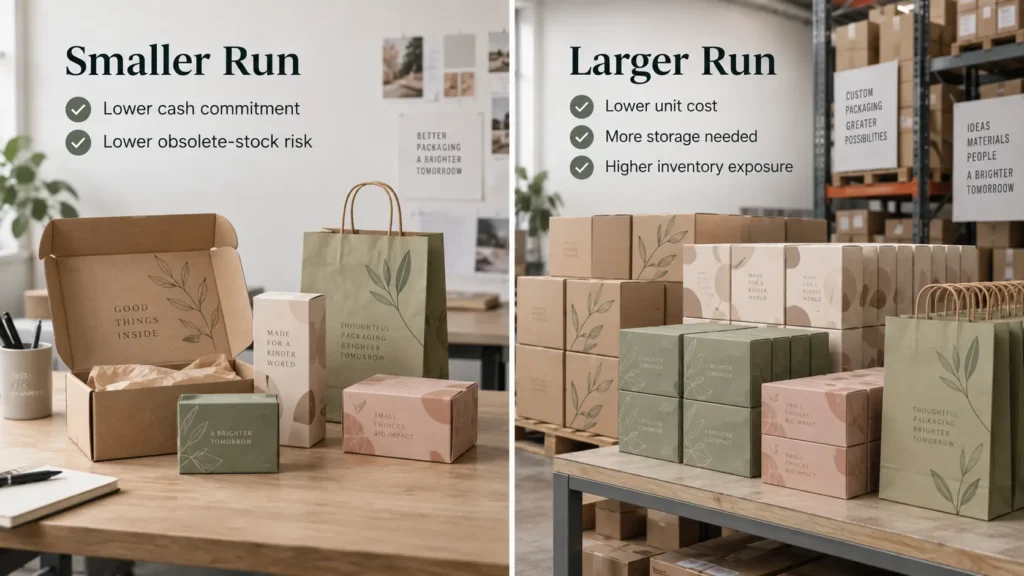
Order above the MOQ only when the incremental saving outweighs the additional cash, storage, and obsolescence exposure. Ask for several realistic quantity tiers using exactly the same size, material, printing, finish, packing, and delivery basis.
| Decision factor | Stay near the MOQ when... | Consider a larger run when... | What to verify |
|---|---|---|---|
| Demand confidence | The product or channel is still being tested | Repeat sales are stable and measurable | Normal, low, and peak demand scenarios |
| Design stability | Artwork, claims, address, barcode, or dimensions may change | The same version is likely to remain usable through the modeled period | Planned rebrand, regulatory, retailer, or SKU changes |
| Cash flow | The extra inventory would restrict product, marketing, or operating cash | The larger purchase fits the working-capital plan | Total cash due and payment milestones, not unit price alone |
| Storage | Boxes arrive assembled or consume valuable warehouse space | Flat packing and available space make storage practical | Carton count, carton dimensions, stacking limits, and storage conditions |
| Reorder reliability | The supplier can reproduce and deliver the packaging predictably | Long or variable replenishment creates a meaningful stockout risk | Approval point, production window, shipping method, and peak-season capacity |
Swipe horizontally to view the full table.
Custom printing, tooling, setup, color calibration, finishing, and packing create fixed or semi-fixed costs, so unit cost normally falls as a production run grows. Our guide to paper bag MOQ explains this for printed bags. The exact curve depends on the packaging format and specification.
Factory Observation
Two paper packaging projects can have the same order quantity but different efficient production levels. Size, material, printing method, finish, and the number of artwork versions can change setup efficiency, material use, and the practical MOQ.
Do not compare one supplier’s small-run quote with another supplier’s large-run quote and call the difference a saving. First compare identical quantity tiers and specifications. Then calculate the extra cash committed and the number of months required to use the additional packaging.
How Many Months of Packaging Should You Hold If the Design May Change?
The less stable the design or product, the shorter the inventory commitment should be. Stay near the smallest workable run when testing a product, changing dimensions, waiting for retailer approval, revising claims, entering a new market, or planning a rebrand.
A longer run is easier to justify when the design is evergreen, sales are repeatable, storage is controlled, and the packaging fits several compatible SKUs. Neutral outer packaging with variable stickers, sleeves, tags, or cards can reduce inventory tied to one campaign.
Accounting context: IAS 2 notes that damaged or obsolete inventory may require a write-down, reinforcing why design-change risk belongs in the order decision (IFRS Foundation).
How Should New Products and Seasonal Packaging Be Ordered?
Separate uncertain or short-lived demand from stable demand instead of averaging everything into one large order. New launches and seasonal designs require different assumptions from repeat evergreen packaging.
- New product: Use a conservative scenario and treat the first run as validation. If MOQ greatly exceeds modeled need, consider stock packaging with a custom sticker, tissue, card, or sleeve.
- Seasonal campaign: Calculate it separately and set a final-use date. Keep evergreen cartons separate from holiday sleeves, tags, tissue, or cards.
- Promotion or wholesale order: Add demand only when the event or order is sufficiently confirmed. Check whether bundles and case packs change packaging use per order.
How Do You Set a Packaging Reorder Point Before Stock Runs Out?
Your packaging reorder point is the quantity that should remain when the next replenishment order is triggered. It is not the quantity you purchase.
Packaging reorder point = adjusted daily packaging use × total replenishment lead time + safety stock
This follows the inventory relationship documented by both Oracle NetSuite and Shopify. For custom packaging, the important adjustment is how you define lead time.
Do not count only machine time. Include specification review, artwork correction, sampling, material preparation, production, finishing, inspection, packing, freight, customs, and receiving where applicable. Use the current supplier quotation and approval process. Our custom packaging production timeline shows the relevant stages.
Review the reorder point whenever demand, shipping method, supplier performance, design, or sales season changes. A fixed annual setting is unreliable when the inputs are no longer current.
What Should You Ask a Supplier Before Choosing the Final Quantity?

A supplier should help you make the quantity assumptions visible before asking you to approve the largest price break. Send the same specification for every tier so the comparison remains like for like.
- Does the MOQ apply per size, design, color, material, structure, or total purchase order?
- Which production constraint creates the MOQ: material purchasing, printing setup, tooling, finishing, or packing?
- Can the supplier quote two to four realistic quantities using the same specification?
- What event starts the lead time: deposit, artwork approval, sample approval, or material confirmation?
- How many cartons will each quantity require, and what are the carton dimensions?
- Can related SKUs share a size, structure, material, or setup without compromising identification?
- If split delivery or supplier storage is offered, when does ownership transfer and what fees, limits, insurance, and release terms apply?
For apparel projects with boxes, paper bags, tissue, stickers, hang tags, woven labels, care labels, and cards, calculate each component separately. The number of tissue sheets or stickers used per shipment may not equal the number of mailer boxes. The custom clothing packaging quote checklist can help you prepare the full specification before requesting tiers.
Factory Observation
For a repeat order with unchanged artwork, approved dimensions, and known usage, a larger run is easier to evaluate. For a first order, we check how much could change after the product is packed and the physical sample is reviewed before recommending a longer inventory commitment.
Ready to validate the full packaging plan? Send the project details needed for a production and quote review.
- Selected quantity and final specifications
- Artwork status and sample requirement
- Deadline and delivery country
The review can then compare your chosen quantity with the actual production method, approval path, packing basis, and delivery requirement.
FAQ: Packaging Order Quantity and Reorder Planning
A small business should order enough packaging to cover demand through the full replenishment lead time and its chosen post-delivery coverage period, plus safety stock and non-sales use. Subtract usable and confirmed inbound inventory, then compare the result with MOQ, cash flow, storage space, and the risk that the design may change.
There is no universal number of months. Keep a shorter commitment for new products, seasonal artwork, changing specifications, or uncertain demand. A longer coverage period is easier to justify when sales, artwork, dimensions, storage conditions, and supplier lead times are stable.
Reorder when usable inventory reaches the expected packaging use during the complete replenishment lead time plus safety stock. Include artwork approval, sampling, production, inspection, shipping, customs, and receiving where they apply—not only the factory’s machine time.
Do not assume either. Ask whether the MOQ applies per size, artwork, color, material, structure, or production setup. Two designs may sometimes share part of a run, but the supplier must confirm whether separate setup or material constraints still apply.
Do not automatically raise the order to the MOQ. Ask whether a standard size, simpler finish, fewer artwork versions, or a different print route can lower the production minimum. If not, compare the higher unit cost of a more flexible route with the inventory risk of the larger run.
Calculate Demand First, Then Negotiate the MOQ
The right custom packaging order quantity begins with usage, total replenishment lead time, safety stock, and a realistic coverage period. MOQ, unit price, cash flow, storage, and design stability then determine whether that calculated quantity is commercially sensible.
If the supplier’s MOQ is higher than your safe requirement, do not treat excess inventory as an unavoidable bargain. Compare simpler specifications, fewer versions, more flexible branding components, and alternative production routes. When demand becomes stable, rerun the calculation and use tiered quotes to decide whether a larger production run is finally justified.
Sources Referenced
Tell Us About Your Packaging Project
Share your packaging needs, and our team will recommend the right solution for your project.