
Table of Contents
Quick Answer: Custom skincare boxes should be chosen around the product format, sales channel, label space, and shipping risk. Serums usually need tight inserts and upright protection, creams need structure that protects heavier jars, and skincare sets need coordinated trays or partitions. For e-commerce, the retail box should usually be supported by tissue, filler, or an outer mailer box.
Not sure which structure fits your skincare products?
Send us your product dimensions, filled weight, sales channel, and artwork status. We can help review the box structure before sampling and suggest a practical direction for retail or e-commerce packaging.
Ask for a Skincare Box Structure ReviewStart With the Product and Sales Channel Before Choosing a Custom Skincare Box
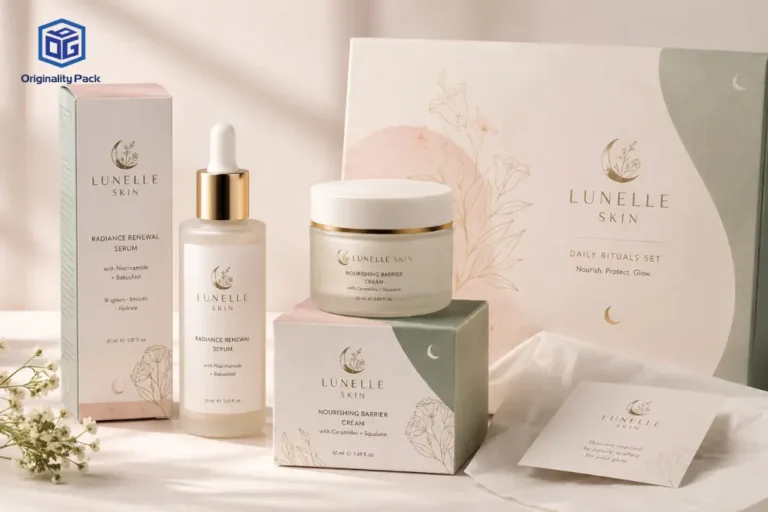
The safest custom skincare box is not always the thickest or most decorative one. It is the box that fits the product format, protects the container, leaves enough label space, and matches how the product will be sold. Before asking for a quote, prepare the container dimensions, filled weight, product count per set, artwork status, and whether the box will be used for retail, online shipping, influencer kits, subscription boxes, or gift sets.
For a product-category reference, see Originality Pack’s custom skincare box page. For broader box structures, the custom paper box page can help compare folding cartons, mailer boxes, and retail paper boxes.
| Skincare Product | Recommended Box Direction | Why It Works | Risk If Chosen Wrong |
|---|---|---|---|
| Serum bottle | Folding carton with snug paper insert or die-cut holder | Reduces bottle movement and protects dropper or pump area | Bottle may move, dropper may rub, or glass may need extra outer protection |
| Cream jar | Stronger paperboard carton or small rigid box for heavier jars | Supports filled weight and gives more stable shelf presentation | Box may bulge, crush, or increase freight cost if the structure is overbuilt |
| Skincare set | Rigid box, drawer box, or folding set box with tray or partitions | Keeps multiple items organized and improves gift presentation | Items may shift, collide, or create a messy unboxing experience |
| E-commerce skincare order | Retail box plus tissue, filler, or outer mailer box | Separates product branding from shipping protection | Retail carton may crush or arrive with damaged corners during parcel handling |
How to Package Serum Bottles Without Movement, Tight Cartons, or Dropper Damage
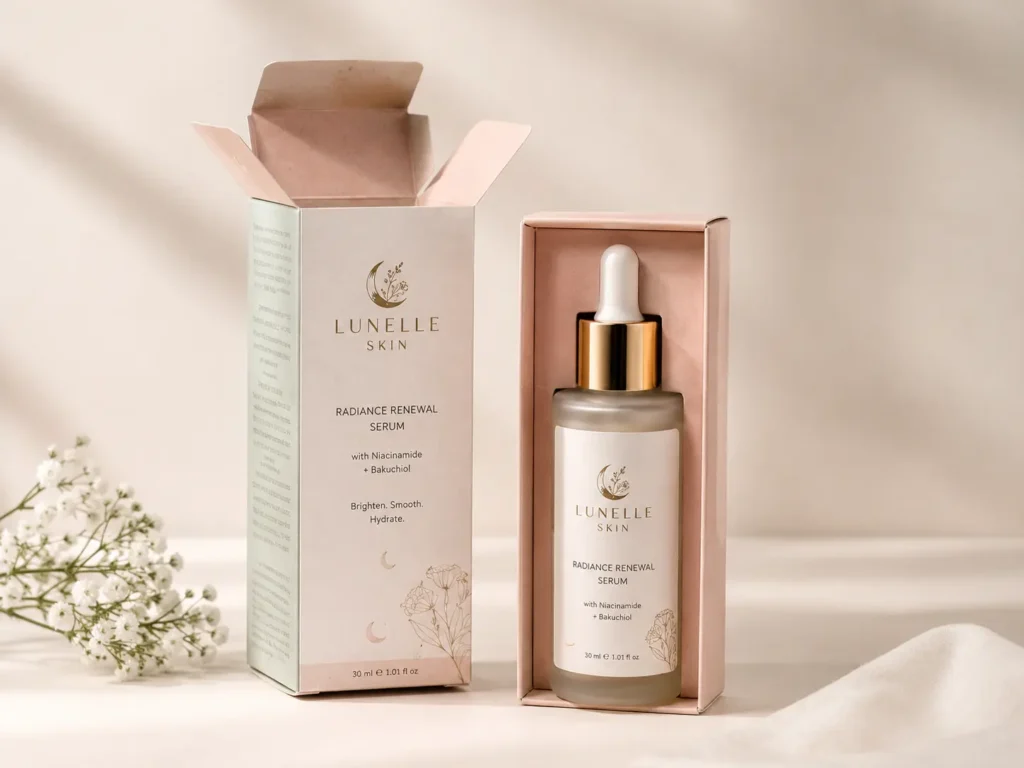
Serum packaging boxes need tight size control because the product is often tall, narrow, and fragile. The risk is not only breakage. If the carton is too loose, the bottle can move during parcel handling. If it is too tight, the dropper, pump, or cap can rub against the inner paperboard and make packing slower during fulfillment.
One issue we often see during sampling is that brands measure only the bottle body and forget the pump or dropper height. The dieline looks correct on screen, but after filling, the approved carton becomes too tight. For glass serum bottles sold online, use an outer corrugated mailer box or shipping carton instead of relying only on the retail box.
Before sampling, confirm whether the serum bottle needs a paper insert, an outer mailer box, or both. The safest answer depends on bottle size, filled weight, cap height, and sales channel — our mailer box sizing guide covers how to measure the packed product and set internal clearance correctly.
How to Package Cream Jars Without Paying for Unnecessary Structure
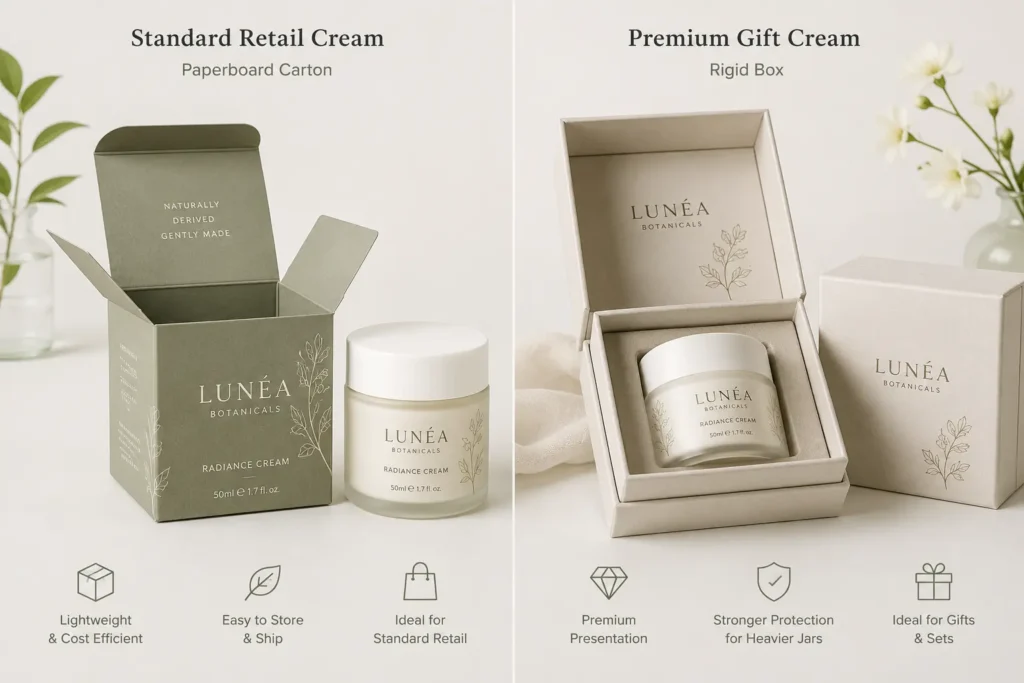
Cream packaging boxes need more attention to filled weight and stacking pressure. Many buyers upgrade to rigid boxes before checking the actual filled weight of the jar. This often increases unit cost, storage volume, and shipping cost without improving protection.
For most standard cream jars, coated paperboard with suitable thickness gives a clean print surface and enough stiffness for retail. A rigid box or reinforced folding carton is more useful when the jar is heavy, sold as a gift product, or needs a stronger unboxing presentation. Start with filled jar weight, shelf display requirement, and whether the product ships individually or inside a set.
When Skincare Sets Need Trays, Partitions, or Rigid Boxes
Skincare set packaging becomes more complex because every item needs a fixed position. Choose a paper tray, molded paper insert, or partition when the set needs tidy presentation and product separation. Choose a rigid box for gifting, holiday launches, influencer campaigns, or higher-value retail. Choose a folding set box when the brand needs lower freight volume and a more practical unit cost.
If your skincare set includes tissue paper, stickers, insert cards, or printed sleeves, coordinate them with the main box before sampling. We often see brands approve the outer box first, then add insert cards or tissue later. That can change the tray height, packing sequence, and carton volume.
Originality Pack can also support related paper packaging components such as custom printed tissue paper and custom stickers, which helps keep color, finish, and delivery timing easier to manage.
For sets with bottles, jars, tubes, tissue paper, and insert cards, review the tray layout and packing sequence before making a sample. The outer box alone does not show whether the full set will pack neatly.
Retail vs E-Commerce Skincare Packaging Decisions
Retail packaging needs shelf clarity. E-commerce packaging needs arrival protection. A common mistake is designing the retail box as if it will also be the shipping box. The carton looks good in product photos, but corners can crush when the order moves through courier handling.
For retail, prioritize the principal display panel, barcode placement, readable product identity, and finish quality under store lighting. For e-commerce, prioritize box compression, product movement, outer carton strength, and whether the retail box should arrive without crushed corners. Printed samples often need about 5-10 days, and mass production often needs about 10-25 days after artwork and sample approval, depending on structure, finish, and quantity.
Factory Note: For e-commerce skincare packaging, the most common cost changes come from insert adjustments after real bottle testing, shipping carton volume, finish changes after proofing, and last-minute label or barcode layout revisions.
For direct-to-customer skincare orders, check packed product size and delivery country before approving the retail packaging sample. This helps decide whether the retail box needs an outer mailer or shipping carton — see our comparison of corrugated mailer boxes, rigid boxes, and poly mailers if you’re deciding between structures.
Which Paperboard and Finish Fits Your Skincare Box Without Adding the Wrong Cost?
For most skincare packaging boxes, coated paperboard is a practical starting point because it supports clean color printing, product photography, small text, and barcode readability. Kraft paper can work for natural-positioned brands, but white ink and fine gradients may not look as solid as they do on white coated paper. Soft-touch lamination can suit creams or gift sets, but it may show fingerprints. Foil stamping and embossing can work for hero products, but they add setup cost and can extend sampling or production time.
| Packaging Need | Better Direction | Buyer Risk to Check |
|---|---|---|
| Clean color and small text | Coated paperboard | Barcode, ingredient list, and fine copy must stay readable after printing |
| Natural brand image | Kraft paper | White ink and fine gradients may look weaker than on white coated paper |
| Premium cream or gift set | Soft-touch lamination or rigid box | Fingerprints, higher unit cost, and larger shipping volume should be checked |
| Hero product launch | Foil stamping or embossing | Extra setup cost and possible sampling delay may affect the launch timeline |
| Lower freight volume | Folding carton instead of rigid box | An outer mailer or shipping carton may still be needed for e-commerce protection |
If responsible sourcing matters, ask whether the paper can support a documented claim. FSC explains that its labels include FSC 100%, FSC Recycled, and FSC Mix categories for different sourcing compositions (FSC). Confirm the claim before printing icons, seals, or sustainability language on the box.
Finalize Label Space Before the Dieline Is Approved
One of the most common reasons skincare packaging samples are remade is that ingredient lists, warnings, barcode placement, or distributor information are finalized after the dieline has already been approved. At that stage, the design team may need to shrink type, move the barcode, change a side panel, or remake the sample.
The FDA’s cosmetics labeling guide explains that cosmetic retail packaging commonly uses an outer container such as a box or folding carton, and that required information may need to appear on the outer container or remain legible through it (FDA Cosmetics Labeling Guide). For U.S. cosmetic products, FDA guidance states that cosmetic products and ingredients are generally not pre-approved by FDA, except for some color additives, but firms remain responsible for safe and properly labeled products (FDA Cosmetics & U.S. Law).
Factory recommendation: send final label copy, barcode size, QR code, ingredient list, and market language before approving the dieline. It is faster to adjust panel space before sampling than to rebuild the artwork after the sample exposes the problem.
How to Make Responsible Packaging Claims Without Greenwashing
Many skincare brands want recyclable, recycled, or FSC-certified packaging. Those directions can be useful, but the printed claim must match the actual material and market. The FTC Green Guides say environmental marketing claims should be truthful, not misleading, and supported by a reasonable basis (16 CFR Part 260).
Instead of printing broad phrases such as “eco-friendly packaging,” use more specific wording only when it is supportable, such as paperboard type, recycled-content claim, FSC claim, or plastic-reduction comparison.
What to Check Before Approving a Custom Skincare Box Sample
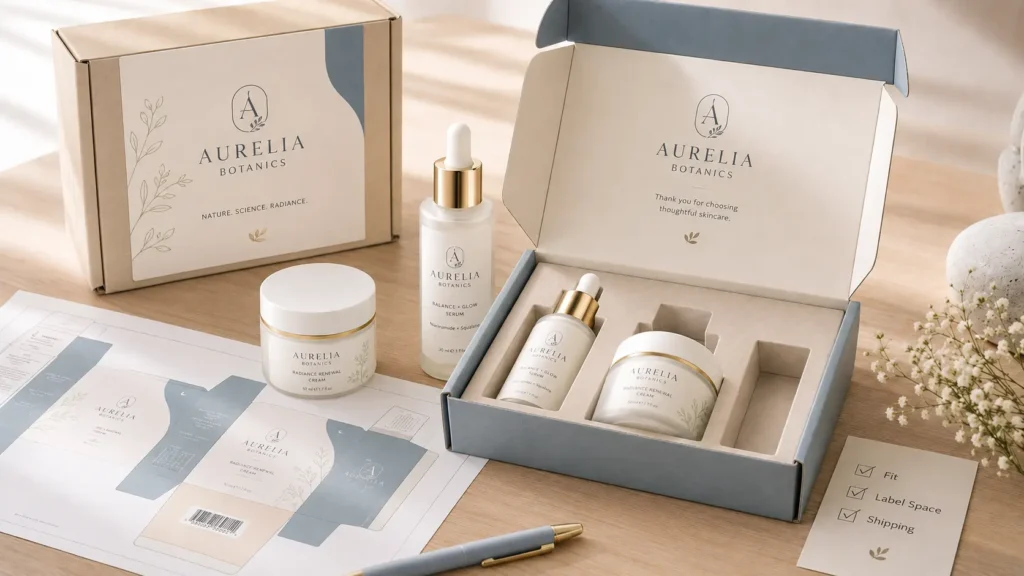
A skincare box sample should be checked with the real product, not only reviewed as an empty printed box. A sample can look correct on a desk but fail after the filled product, insert, tissue, and outer carton are tested together.
Place the filled serum bottle, cream jar, tube, or set components inside the sample. Test the insert, barcode area, opening experience, and whether the outer mailer or carton still fits the packed unit.
- Fit: The bottle, jar, or set components should not move too much, but packing should still be efficient.
- Label space: Required copy, barcode, and product identity should remain readable without crowding.
- Shipping: Check whether the retail box needs tissue, filler, or an outer mailer box.
If you are not sure whether the brief is complete, use the custom packaging quote page to prepare box type, size, material, quantity, finish, sample needs, and delivery details before production.
Common Mistakes Skincare Brands Make
Only designing for the front panel
A beautiful front panel can still fail if the side or back panels do not leave enough space for ingredients, warnings, barcode, or distributor information.
Using the same box logic for serums and creams
Tall serum bottles, heavy cream jars, and mixed skincare sets create different insert, board, and shipping requirements.
Approving a sample without the filled product
Empty bottles and filled bottles do not behave the same. Weight changes how the box stacks, ships, and feels in hand.
Adding finishes before confirming MOQ and timeline
Foil, embossing, soft-touch lamination, and custom inserts can improve presentation, but they add setup cost and may extend sampling or production.
Making vague sustainability claims
Buyers may like responsible packaging, but claims should be specific and supportable. Broad claims can create compliance and trust problems if the material structure does not support them.
Why Ask Originality Pack to Review Your Skincare Box Before Sampling?
Originality Pack is a China-based paper packaging factory that helps overseas skincare brands review box structure, inserts, material, finish, label space, and shipping protection before sampling.
For skincare projects, the value is not only producing the box. It is catching small specification problems before they become a remade sample, higher freight cost, or delayed launch.
FAQ
For most serum bottles, a folding carton with a snug paper insert is the practical starting point. Glass bottles or e-commerce orders usually need additional outer protection, such as a corrugated mailer or shipping carton.
Yes, many skincare sets can use paper trays, paperboard partitions, or molded paper inserts. The best option depends on product weight, bottle shape, presentation requirement, and whether the set will ship directly to customers.
Send AI or PDF artwork with dieline, bleed, vector logo, color references, finishing notes, outlined fonts, barcode position, and final label copy. If the box needs an insert, include real product dimensions or samples.
Conclusion
Custom skincare boxes should be planned from the product outward. Start with the serum bottle, cream jar, or set components, then decide the retail display needs, e-commerce shipping risk, label-space requirements, insert structure, material, finish, and sample type.
Knowledge Takeaway: The right skincare box is not the one with the most expensive finish. It is the one that protects the formula container, supports the sales channel, leaves enough room for required information, and arrives in good condition.
Need help checking your skincare box specifications? Send your product dimensions, filled weight, quantity, artwork status, and sales channel. Originality Pack can review the structure, insert, finish, label-space risk, and shipping plan before quoting.