
Quick Answer
There is no single standard size of tissue paper for every packaging project. OriginalityPack estimates the sheet from the product or packaging dimensions and then checks the actual wrap. Our customers choose 17 GSM most often because it is economical and feels like the lightweight tissue they expect. For a fuller presentation, 28 GSM offers a middle option, while 35 GSM gives high-end apparel packaging a heavier feel but can be harder to fold. Logo size and spacing are arranged from the customer’s artwork and adjusted for production after the layout is confirmed.
Table of Contents
If you are ordering custom printed tissue paper, a “standard size” is useful only as a starting point. The sheet still has to cover your product in the way your team actually wraps it, feel right when folded, and show enough of your logo after the package is closed. A size that looks generous on a flat screen can be too short around a garment or leave every full logo hidden under a fold.
Tissue Paper Specifications at a Glance
When OriginalityPack reviews a custom tissue paper project, we do not begin with a catalog specification. We check how the tissue will sit around the product or inside the packaging, how much of it should remain visible, what feel the brand wants, and how the logo should appear after folding.
| Decision | Start with | Confirm by |
|---|---|---|
| Sheet size | Product or packaging dimensions and the intended wrap | Our size estimate followed by a physical fit test |
| GSM | 17 GSM for the most common economical wrap; 28 or 35 GSM for a fuller feel | A sample folded around the actual product |
| Base color | More than ten existing lightweight tissue colors for smaller orders | Current stock and a physical color sample |
| Printed background | 80–105 GSM paper with offset or gravure printing | Artwork, quantity, coverage, and print review |
| Logo layout | The customer’s preferred logo size and density | Customer layout approval followed by a production check |
Swipe horizontally to view the full table.
Not Sure Which Specification to Start With?
Share these project details so OriginalityPack can review a practical starting specification:
- Product or packaging dimensions
- Intended wrapping method
- Preferred paper feel and color direction
- Logo file or current artwork status
Originality Pack can estimate a starting size and prepare a practical specification for review before quoting.
Which Standard Tissue Paper Size Should You Test First?
Customers often ask us for a standard tissue paper size, but the useful size depends on the item and its packaging. A sheet placed inside a custom paper bag has to travel down one side, across the bottom, and back up the other side. It also needs enough extra height to remain visible above the bag opening.
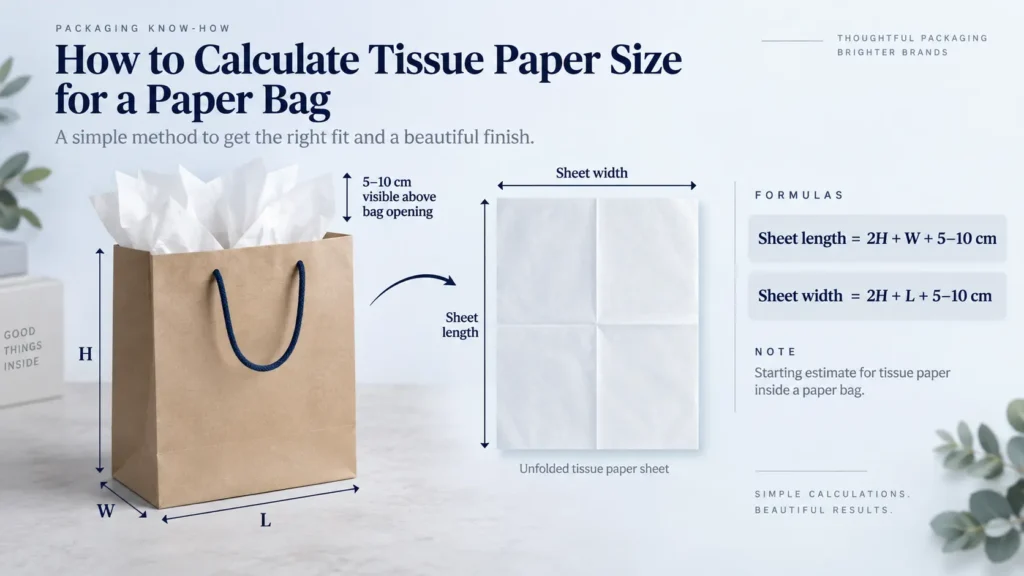
This formula is a starting estimate for a bag liner, not a universal cut-size rule. A loose top layer, a full product wrap, and tissue used inside a box each need a different calculation. OriginalityPack checks the intended use before recommending the sheet.
Our Starting Formula for Tissue Paper Inside a Paper Bag
For a paper bag with front-panel width L, side-gusset depth W, and height H, OriginalityPack uses the dimensions below as a starting estimate for tissue paper placed inside the bag.
Calculate a Starting Tissue Paper Size
Enter your paper bag dimensions and choose how much tissue you want to remain visible above the bag opening.
This is a starting estimate, not a guaranteed final production size. Test the tissue around the actual product and bag before confirming the specification.
The extra 5–10 cm is a presentation allowance for tissue that rises above the bag opening. The exact amount depends on how much tissue you want to remain visible and how the sheet will be folded.
This formula is intended as a starting estimate for tissue used as a bag liner. A loose top layer, a full product wrap, or tissue used inside a box may require a different sheet size.
A sheet passes the fit test when it covers the intended area, sits inside the bag without creating excessive bulk, and leaves the planned amount of tissue and artwork visible. If your packing team needs to trim the sheet, add a second sheet, or change the wrapping method every time, the size should be adjusted before production.
Send us your bag dimensions, wrapping method and logo. We can review the starting size before sampling or quotation.
A sheet passes the fit test when it covers the intended area, sits inside the bag or box without a bulky wad, and leaves the planned amount of tissue and artwork visible. If packers must routinely trim it, add a second sheet, or change the wrap to make it work, the size needs another adjustment.
If you are still comparing paper types and print options, the custom printed tissue paper product page shows the related choices. Keep the final size decision tied to your own product and packing method.
How Do You Measure a Sheet for Your Actual Packaging?
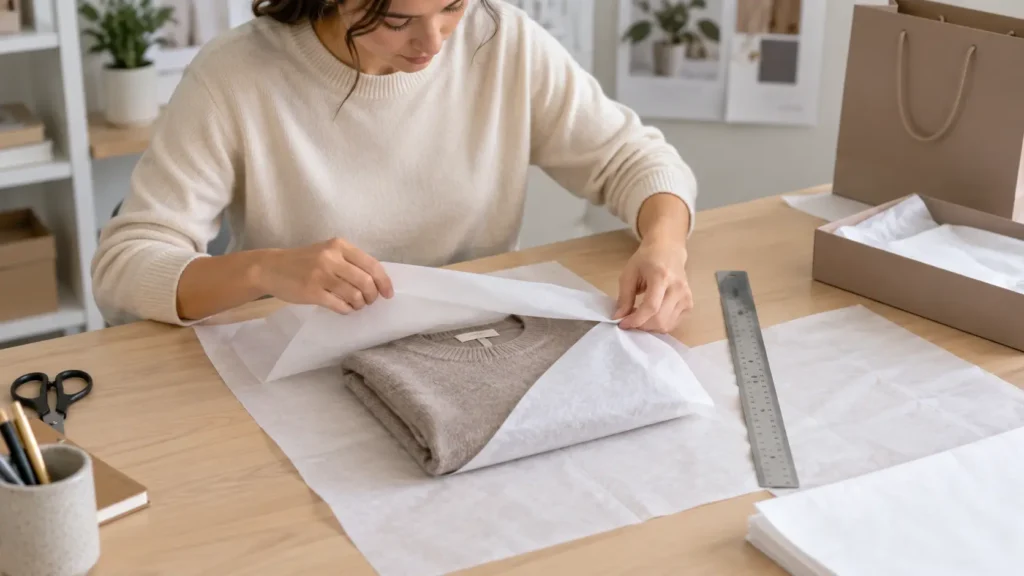
Cut two plain-paper mockups at the candidate sheet sizes before committing to artwork. Pack the real product as your fulfillment team would pack it, then unfold each sheet and measure the paper you actually used. Record the size that passes, its overlap, and the panel a customer sees first. The physical test captures requirements that a product length × width calculation misses.
- Set the packing condition. Use the finished product, including any inner bag, padding, insert, or folded garment thickness. Place it in the actual box or retail bag if possible.
- Choose the job of the tissue. Decide whether it is a liner, a loose presentation layer, a full wrap, or a separator between products. If the shipment also needs impact protection, assess the outer box and protective structure separately.
- Wrap and unfold. Mark the folds and the area a customer sees first. Measure the opened sheet, the overlap you needed, and any excess you would routinely trim or tuck away.
- Repeat with the busiest pack. If you sell several sizes, test the largest or most awkward product as well as the common order. A single sheet specification may fit one SKU beautifully and slow down packing for another.
The output of this test is more useful than “please quote standard tissue.” It gives OriginalityPack the packed product dimensions, intended wrapping method, desired visible height, and usable print area. We can use those inputs to estimate a sheet size and check whether it suits the paper and print process.
What Tissue Paper GSM Fits the Wrap You Want?
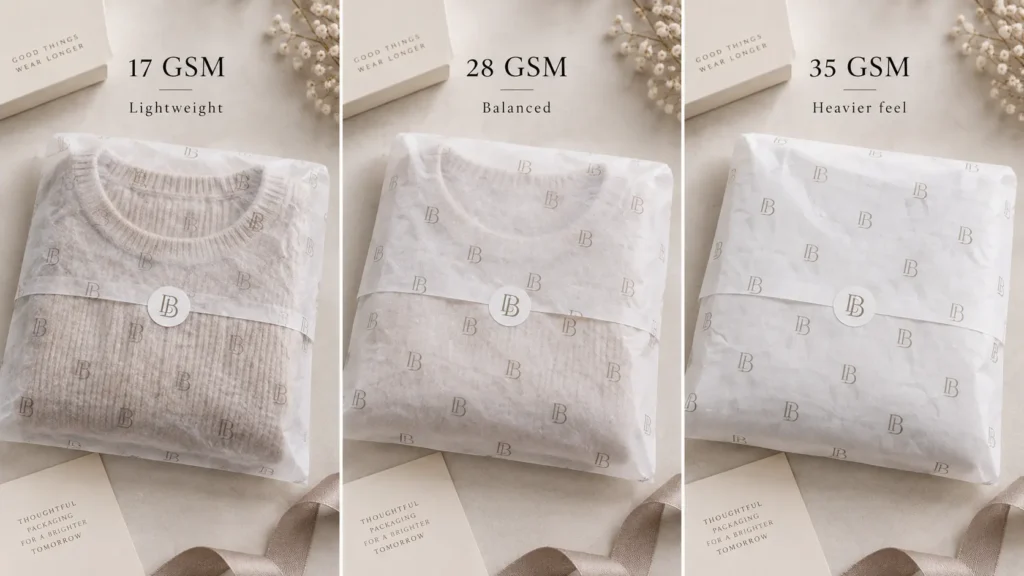
17 GSM is the weight our customers choose most often. It costs less and matches what most buyers expect lightweight tissue paper to feel like. When a high-end apparel brand wants the wrap to feel thicker and more substantial, we compare it with 28 and 35 GSM instead. Our guide to packaging for mailing clothing explains how tissue can work with the surrounding mailer bag or box.
| GSM | Why customers choose it | What to consider |
|---|---|---|
| 17 GSM | Our most frequently selected option; economical and familiar as lightweight tissue | It may feel too thin for a premium presentation |
| 28 GSM | A middle choice for customers who want more substance but consider 35 GSM too thick | Confirm that the added body still folds cleanly around the product |
| 35 GSM | A thicker, more substantial feel often requested for high-end apparel packaging | It creates more fold bulk and can be harder to wrap |
Swipe horizontally to view the full table.
From an OriginalityPack Apparel Project
A high-end apparel customer initially chose 17 GSM, then felt the finished tissue was too thin for the presentation they wanted. After we explained how the available weights would change the hand feel and fold, the customer changed the next order to 35 GSM. The lesson is not that 35 GSM is always better; the paper has to match the position of the product and the way it will be wrapped.
GSM means grams per square metre: it describes paper mass per area. It is not the same measurement as thickness or a guarantee of softness. Tissue-specific standards treat the two as separate properties: ISO 12625-6 covers grammage, while ISO 12625-3 covers thickness and bulk. In practice, OriginalityPack asks the customer to compare hand feel and fold bulk on the real product; our custom packaging sample approval checklist shows how to record this with dimensions, color, artwork, and packout before mass production.
Ask us to review the tissue color and print coverage on that sample, especially for dark or dense artwork. A digital proof can show placement, but it cannot reliably show the hand feel, transparency, or ink appearance of the finished sheet. If printed tissue will touch light-colored apparel or other sensitive surfaces, tell us before approval so production can review the requirement.
Can Tissue Paper Have a Colored Background?
Yes. OriginalityPack has more than ten existing colors for lightweight tissue, subject to current paper stock. For a smaller order, choosing an existing paper color is the practical route because the base color of lightweight tissue comes from the paper itself; it is not normally created by printing a full background onto white tissue.
If the design requires a printed background color, we can discuss 80–105 GSM paper with offset or gravure printing. This produces a different result from lightweight 17–35 GSM tissue: the heavier sheet can carry the printed background, but it also feels and folds more like paper. Tell us whether you want colored lightweight tissue with a logo or a background color printed on heavier paper so we can review the appropriate route.
How Much Space Should You Leave Between Repeated Logos?
There is no single correct logo size or spacing. Some customers want a large, open repeat; others prefer smaller logos placed more closely together. OriginalityPack begins with the customer’s visual preference rather than forcing every project into one repeat rule.
After the customer sends the logo, our design team prepares the tissue paper layout for confirmation. The proof should show the full sheet, logo size, repeat direction, horizontal gap, row gap, and sheet edges. Once the customer confirms the look, our production department checks the layout against the actual printing and converting process and makes any small production adjustments that are needed.
We also recommend checking the layout after folding. A large logo may look strong on a flat proof but disappear under the final fold; a smaller repeat may keep a complete mark visible more consistently. If the logo includes small text or delicate strokes, provide a vector file so we can review whether the intended printed size will remain legible.
Already Have a Tissue Paper Layout?
Have the logo ready and share the details that affect the repeated pattern:
- Sheet size
- Intended fold
- A large open repeat or a smaller, denser pattern
- Current dimensions in the project description
We can follow up to receive the artwork, prepare the layout for confirmation, and have production review it before printing.
What Should You Confirm Before Requesting a Sample or Quote?
Bring the size, GSM, color, and artwork decisions together in one brief. You do not need to know every answer before making an inquiry; identifying what remains open helps OriginalityPack recommend an appropriate sample and quote from the same assumptions.
- Product and pack: What item will be wrapped? What are its packed dimensions, and will it go in a box, mailer, or bag?
- Wrapping method: Is the tissue a liner, top layer, full wrap, or separator? Which side is visible when opened?
- Sheet size: For a paper bag, provide L, W, and H. For another pack, give the product and packaging dimensions and explain how the tissue will be used.
- Paper and print: Do you prefer economical 17 GSM, a fuller 28 GSM, thicker 35 GSM, or 80–105 GSM paper with a printed background? Do you want an existing lightweight tissue color or a printed base color?
- Logo layout: Provide the logo and tell us whether you prefer a large open repeat or a smaller, denser pattern. Our team can prepare the exact layout for confirmation.
- Order context: Approximate quantity, number of product sizes, delivery country, and whether you need a physical sample before bulk production?
A buyer could write: “Our paper bag has a 30 cm front-panel width, 12 cm side gusset, and 25 cm height. The tissue will line the bag and should remain visible above the opening. We are packing high-end apparel and want to compare 28 and 35 GSM with a repeated one-color logo. Please estimate a sheet size and prepare a layout for review.”
Will a Standard Sheet Work for Your Packaging?
Share the information already available for your tissue paper project:
- Product or packaging dimensions and intended fold
- Approximate quantity
- Preferred feel and color
- Logo file status and any open questions
OriginalityPack can estimate the sheet size, recommend a GSM and color route, and follow up to prepare the repeat layout for confirmation. It is fine to leave an undecided specification open. On the quote form, select Tissue Paper and put your current measurements and open questions in the project description.
Choose the Sheet That Works After It Is Folded
The best tissue-paper specification is not the most common catalog size or the highest GSM. It is a sheet calculated for the way your product is packed, with a weight that delivers the intended feel and a logo layout that still works after folding. Give Originality Pack the packaging dimensions, preferred presentation, color direction, and logo; we can turn them into a size estimate and layout for sampling and quotation.
Tell Us About Your Packaging Project
Share your packaging needs, and our team will recommend the right solution for your project.