
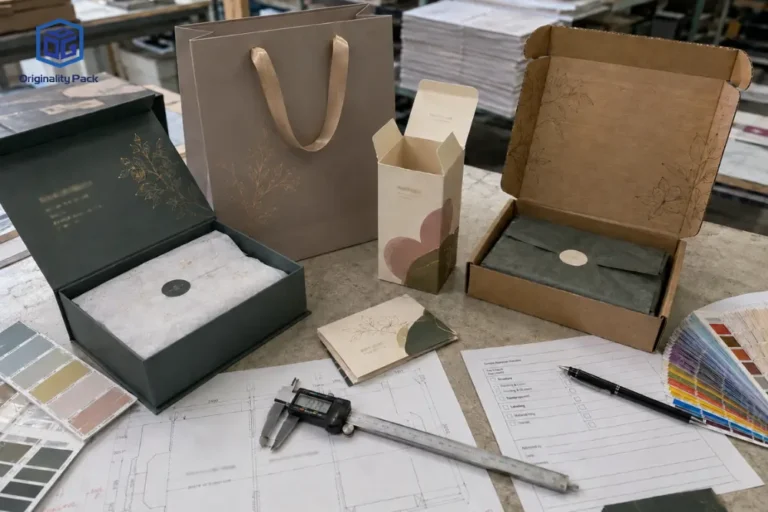
Quick Answer
Before approving a custom packaging sample, confirm its version, product fit, dimensions, material, structure, artwork, color, finishes, barcode, accessories, and packout. Record what the sample represents, what remains approximate, and which changes require reapproval. The goal is to approve a production standard that the buyer, factory, and QC team can follow—not only an attractive sample.
Table of Contents
Key Takeaways
- First identify what the sample represents, what is approximate, and what is not included.
- Test the real product, dimensions, closure, insert, and assembly before judging appearance.
- Compare material, color, print, and finishes against controlled specifications or physical references.
- Record photo references, filenames, tolerances, approvers, and the changes that require reapproval.
- Choose the sample method by the risk you need to verify; a small order may only need an approximate digital printed sample.
Digital Proof, Structural Prototype, Digital Sample, and Pre-Production Sample: What Is the Difference?
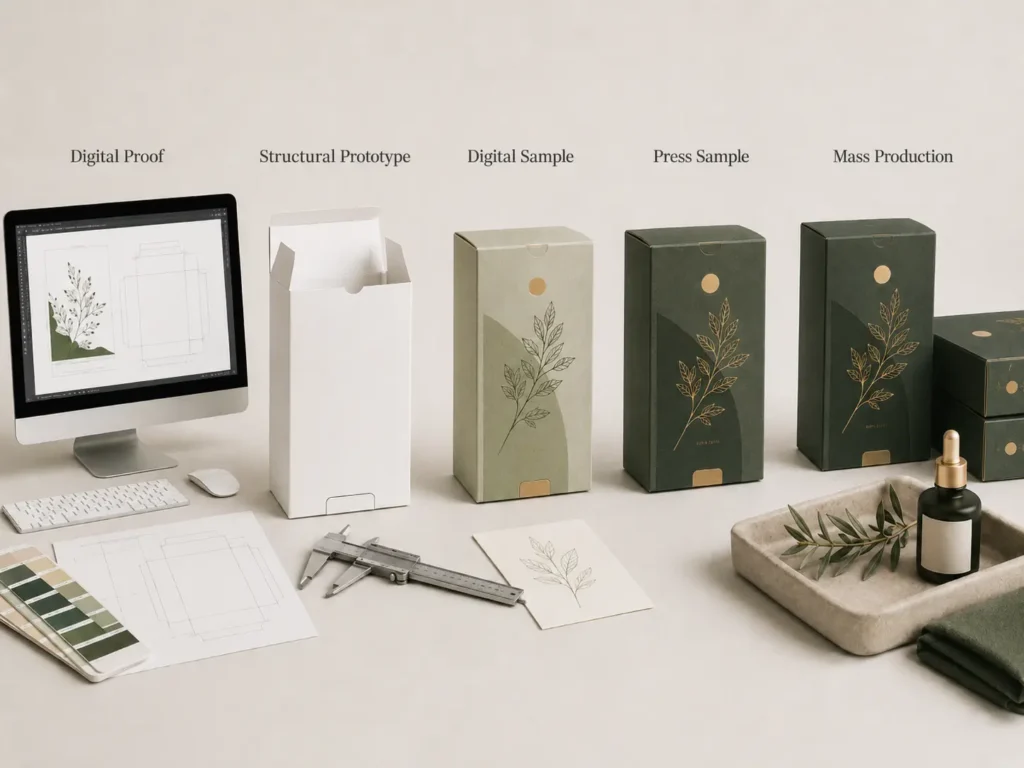
A digital proof approves files; a structural prototype approves fit; a digital printed sample previews approximate appearance; a pre-production sample describes the approval stage; and a production-method sample shows only the processes it actually represents.
Packaging samples can be described by their format, production method, approval stage, or approval status. A pre-production sample describes when the sample is reviewed; a golden sample describes its status after approval.
Choose the sample by the decision you still need to make. Because suppliers may use the names differently, ask how the sample was made and which parts match mass production.
| Sample Type | Best Used to Approve | Cannot Approve Alone | Practical When |
|---|---|---|---|
| Digital proof or 3D rendering | Copy, panel direction, artwork position, and dieline relationship | Physical fit, material, printed color, finish, or assembly | Before physical sampling or for a controlled artwork-only repeat change |
| Structural prototype or white dummy | Dimensions, folds, opening, closure, product fit, and insert layout | Final print, color, and decorative finish | Structure and fit are the main risks |
| Digital printed physical sample | Overall presentation, approximate color direction, artwork scale, structure, and fit | Exact offset/flexographic color or unrepresented finishes | A small order needs a physical preview without full machine setup |
| Pre-production sample | The final buyer-and-factory approval decision before mass production, within its written scope | Any material, print, finish, fit, or test that its actual making method does not represent | The project is ready for a documented production-release decision |
| Production-machine or production-method sample | The specified production-intent material, printing, finishing, die cutting, gluing, or assembly processes actually used | Unrepresented downstream processes, order-wide uniformity, transport performance, or final inspection results | Color, finish, structure, or order risk justifies closer production representation |
Swipe horizontally to view the full table.
Use a Three-Part Approval Boundary
Every sample should state what is represented, what is approximate, and what is not represented.
- Represented: attributes made with the approved material or production-intent process and included in this approval.
- Approximate: attributes that show direction but are not the final production standard, such as offset color previewed by digital printing.
- Not represented: omitted finishes, different materials, transport performance, batch consistency, or any other untested requirement.
Originality Pack Project Note: For a small order, a digital printed sample is often the practical choice when the buyer needs an approximate physical preview but does not want to absorb full press setup. If bulk production will use offset printing, pair the sample with the actual paper and finish references, and treat its color as directional rather than exact.
A production-machine sample is useful only when its scope is written down. It may be only a printed press sheet, sometimes called an on-machine or press sample, rather than a fully finished package. Lamination, foil, die cutting, gluing, and assembly are represented only when the sample specification says so.
10-Point Custom Packaging Sample Approval Checklist Before Mass Production
Use the full checklist only after the sample type and approval boundary are clear. Each approval point needs a test, a reference, and a record—not a general “looks good” message.
For each checklist item, select PASS, REVISE, N/A, or HOLD. Use N/A only when the item is outside the agreed sample scope; use HOLD when missing information prevents approval.
| Check Item | How to Inspect It | Compare Against | Evidence to Record | Do Not Approve When |
|---|---|---|---|---|
| Version | Match sample label, artwork, and dieline | Latest approved files | Version code and filenames | Any file or SKU is unclear |
| Dimensions and fit | Measure and load the real product | Approved specification | Measurements and fit photos | The product binds, moves excessively, or prevents closure |
| Material and structure | Check paper, board, reinforcement, folds, and glue | Material schedule | Material name, GSM, caliper, flute, or board thickness as applicable | A substitute is used without written acceptance |
| Artwork and copy | Proofread every panel and SKU | Final artwork | Approved PDF or AI revision | Text, orientation, language, or legal copy is wrong |
| Color and print | Review under consistent lighting and check registration | Physical color reference and approved print target | Reference code and viewing notes | Color is judged only from a phone photo |
| Finishes | Inspect adhesion, alignment, coverage, texture, and edges | Finish map and physical reference | Close-up photos and finish codes | The sample only simulates a critical finish |
| Barcode and QR code | Confirm data, quiet area, contrast, size, and verification requirement | Approved code file and market requirement | Verification report when required | The code only passes an informal phone scan |
| Accessories | Assemble the complete packaging set | Packout sequence | Component list and packed photos | An insert, card, tissue, sticker, or label conflicts with another item |
| Outer packing | Pack units into the planned inner and master cartons | Carton and shipping plan | Pack quantity, orientation, and carton photos | The approved retail pack has never been checked in its shipping configuration |
| Approval boundary | List represented, approximate, and unrepresented attributes | Sample request and QC plan | Signed approval record | The buyer and supplier interpret the sample differently |
Swipe horizontally to view the full table.
Why Should You Check the Real Product, Dimensions, Structure, and Assembly First?

Approve fit before appearance because an attractive package still fails if the product cannot be packed, protected, removed, or presented correctly. Use the final product, or an approved master with controlled dimensions and weight, instead of relying only on product photos.
- Insert and remove the product without forcing it.
- Check whether it rotates, rattles, or contacts a sensitive surface.
- Load every accessory, manual, card, cable, or tissue layer before closing.
- Confirm that inserts do not press buttons, caps, labels, pumps, or fragile parts.
- Check the opening direction and how the product is presented to the customer.
- Load custom paper bags with the real weight and inspect handles, top fold, bottom card, and glued seams.
For mailer boxes, record whether dimensions are internal or external. The custom mailer box sizing guide explains how product fit, insert space, board thickness, and shipping size affect the final specification.
How Should You Check Material, GSM, Board Thickness, and Hand Feel?
Record the material specification; do not approve by touch alone. GSM measures mass per area, but does not independently prove stiffness, thickness, compression strength, or carrying performance.
- Paper bags: paper type, GSM, handles, top fold, bottom card, and reinforcement.
- Folding cartons and custom paper boxes: board grade, caliper, folding behavior, creases, and closure.
- Luxury rigid boxes: greyboard thickness, wrap paper, corners, edges, and panel alignment.
- Corrugated mailer boxes: flute, board combination, folds, locking tabs, cut edges, and loaded shape.
- Inserts: material, thickness, cavity, support points, product contact, and removal space.
Thicker material can change folds, internal space, cost pressure, and shipping weight. Approve a structure that meets the product, retail, and distribution requirement—not thickness for its own sake.
How Should You Approve Color, Copy, Barcodes, and Print Position?
Tie color approval to the substrate, print method, finish, and physical reference. Pantone notes that the same Pantone color can look different on coated and uncoated paper because ink reacts differently with each surface (Pantone).
Compare samples under consistent viewing conditions. ISO 3664:2025 specifies conditions for critical comparison and routine inspection of reflective prints. Avoid “slightly warmer” or “close enough” unless the project defines an acceptance reference or measurable tolerance.
Proofread every panel and SKU, then check registration, small text, reverse text, logo position, language, instructions, legal copy, and opening direction against the dieline.
A phone scan is not formal barcode verification. GS1 states that a compliant verifier measures printed-symbol parameters and provides an overall grade under the relevant ISO/IEC standards (GS1). Confirm the requirement with the receiving retailer or warehouse.
For deeper guidance on substrate, process, and batch effects, see packaging color consistency and batch variation.
How Should You Inspect Lamination, Foil, Embossing, and Spot UV?
Special finishes should be approved where they interact with the real paper and print—not as isolated names on a specification sheet. Inspect the finished package at normal viewing distance and again in close-up.
- Lamination: check bubbles, peeling, silvering, scratches, fingerprints, edge lifting, and changes to dark-color appearance.
- Foil stamping: check foil code, tone, coverage, pinholes, adhesion, edge sharpness, and alignment with the printed artwork.
- Embossing or debossing: check depth, registration, paper cracking, reverse-side marking, and whether fine details remain readable.
- Spot UV: check the gloss level, coverage, dust, pinholes, edge definition, and registration over the intended artwork.
A digital sample may omit or simulate these effects. If a finish is central to the approval decision, request a physical process reference or a finished production-method sample. The trade-off is additional setup and time, so a simple small order may be better served by a digital sample plus approved material and finish swatches.
How Should You Check Inserts, Cards, Tissue Paper, Stickers, and Other Components Together?
Approve the complete packout when the customer receives a system rather than one box. Components that look correct separately can conflict when assembled.
- Confirm the insert supports the product without covering labels or damaging surfaces.
- Fold tissue as intended and apply stickers to the actual surface.
- Place cards and manuals in their final orientation before closing the pack.
- Compare colors across paper, tissue, stickers, tags, and labels while allowing for process differences.
- Photograph the final packing sequence for production and fulfillment.
Ask whether all components fit, assemble, and present correctly in the intended order—not only whether each item looks good alone.
Should the Packaging Sample Include Outer Carton, Stacking, and Transport Checks?
A visually approved retail package is not automatically an approved shipping system. Check the full packout: outer mailer, inner carton, master carton, dividers, protection, quantity, orientation, empty space, edge contact, stacking deformation, closure, and surface rubbing.
For higher-risk products, choose a test that matches the route. ISTA’s 1G overview requires the shipper to define acceptable product damage and package condition before testing, and says samples should use the actual package and product or the closest possible substitutes (ISTA). Sample approval and transport testing remain separate decisions.
If shipment timing affects when tests, revisions, and production can happen, review the custom packaging production timeline before releasing the order.
What Photos, Version Numbers, Specifications, and Golden Samples Should Be Retained?
A packaging golden sample is an approved physical reference—not a sample-making method—and it is valid only when linked to the final specification, files, version, approval scope, and date.
It may begin as a digital printed sample or production-method sample, but the approval record must state exactly what it represents.
Keep front, back, side, interior, finish close-up, product-fit, packed-configuration, and critical-measurement photos. Record who holds the buyer and factory references, and protect retained samples from fading, crushing, moisture, or uncontrolled handling.
Minimum Packaging Sample Approval Record
If you are not using the downloadable PDF, copy these fields into the buyer and factory project record. Link the completed record to the retained golden sample and final files.
Do not write “approved, but make the box smaller and the color darker.” That is a revision request, not production approval. Release production only after the revised dimensions, artwork, material, or color instruction has passed the agreed approval route.
When Can You Approve the Sample, and When Is a Revised Sample Required?
Approve only when critical attributes are represented, the sample meets the agreed standard, and every limitation or accepted deviation is documented. Do not expect zero variation, but do not accept an undefined difference.
A Digital Proof May Be Enough When
- The order repeats an approved structure, material, print method, and finish.
- Only controlled copy, date, SKU, or artwork changes; no physical risk changes.
A Digital Printed Sample May Be Enough When
- The quantity is small and approval focuses on approximate appearance and fit.
- Bulk uses a comparable digital process, or exact color and complex finishes are not critical.
- Unrepresented materials and finishes are approved with physical references.
Request a Revised Physical or Production-Method Sample When
- Dimensions, dieline, product, insert, closure, or assembly changes.
- Material, flute, thickness, handle, adhesive, or reinforcement changes.
- Color-critical printing or an important finish changes.
- The sample is damaged, unlabelled, or cannot be linked to final files.
Sample approval does not remove the need for production setup checks, in-process QC, final inspection, or transport testing where these are required. Buyers ordering internationally should connect sample standards with specifications, QC expectations, export packing, and shipping responsibility; the guide to ordering custom packaging from China covers that wider control process.
Not sure which sample you need? Share the decisions the sample must prove before paying for a more complex sample process.
- Packaging type, quantity, and artwork status
- Product-fit and structural requirements
- Critical colors, materials, and finishes
Originality Pack can help identify what can be checked with a digital sample and what requires a physical or production-method sample.
Common Mistakes Brands Make Before Mass Production
Approving by sample name. “Pre-production sample” is not enough information. Record the materials and processes it actually represents.
Checking an empty package. A box may fold well when empty but fail after the product, insert, tissue, card, and accessories are loaded.
Treating a digital sample as an exact offset color standard. A digital sample is useful for approximate visual approval, but different inks, screening, substrates, and finishes can change the production result.
Paying for a production-machine sample without defining the risk. Full press setup adds cost pressure and time. Use it when color, material, finish, structure, or order risk justifies it.
Approving color from phone photos. Camera processing, screens, lighting, paper, and finish can all change appearance.
Scanning a barcode once and calling it verified. Confirm the required barcode quality method for the destination retailer or warehouse.
Changing one detail after approval without reopening the gate. A small size, material, or finish change can affect fit, color, folding, tooling, packing, and production feasibility.
Keeping no golden sample or version record. Without a controlled reference, “match the approved sample” becomes an opinion.
FAQ
It may be enough for approximate appearance, structure, and fit, especially when bulk also uses digital printing. Approve offset color or critical finishes separately when they are not represented.
It may require plates, ink calibration, press time, production materials, tooling, and finishing setup. Those setup requirements are spread across very few samples.
They can confirm version and visible workmanship, but not material feel, physical fit, accurate color, closure force, or tactile finishes.
No. It defines the target and acceptance standard; setup control, in-process QC, and final inspection still manage production variation.
Changes to size, structure, product, material, print method, color, critical finishes, insert, or packout may require a new physical review. A controlled text-only repeat change may need only a revised digital proof.
When practical, both buyer and factory should retain labelled references linked to the same artwork, dieline, material specification, and approval record.
Conclusion: Approve a Production Standard, Not Just an Attractive Sample
A reliable custom packaging sample approval checklist connects the physical sample to the real product, final files, material specification, production method, finishes, accessories, packout, and written acceptance standard. The most important question is not whether the sample looks good. It is whether both buyer and factory understand exactly what has been approved for mass production.
If you are still comparing box, bag, insert, or accessory formats, review the available custom packaging options for brands before finalizing the sampling route.
Preparing a packaging project for production? Share the specifications already confirmed and the points that still need review.
- Packaging type, dimensions, and quantity
- Materials, artwork, and key finishes
- Product-fit requirements and delivery country
Originality Pack can review the structure, sampling needs, and production feasibility before quoting.