

Quick Answer
Choose corrugated flute types by product weight, fragility, box size, printing, stacking and shipping route. E flute suits lightweight printed mailer boxes; B flute adds rigidity for heavier mailers; C flute balances general shipping needs; A flute emphasizes cushioning; and double-wall board is considered when a single wall cannot provide enough protection.
Table of Contents
Buyers often specify only “E flute” or “B flute,” but that is not a complete box specification. Two boxes using the same flute can perform differently when their paper, dimensions, flute direction or structural design changes. This guide shows how to choose enough protection without paying for unnecessary thickness, shipping volume or material.
For ecommerce projects, compare these decision points with our custom corrugated mailer boxes.
Why Corrugated Flute Changes Protection, Printing and Shipping Cost
A flute is the wave-shaped paper medium bonded between flat linerboards. Its arches help resist pressure across the board, while its vertical structure contributes to stacking performance. The European Federation of Corrugated Board Manufacturers describes single-wall board as one fluted layer between two liners; double- and triple-wall boards add more layers.
Taller flutes generally provide more cushioning and thickness. Smaller, more closely spaced flutes create a flatter printing surface and tighter folds, but may not protect a heavy, fragile or oversized product.
Factory recommendation: Prioritize printing and folding for lightweight presentation packs. Put protection and compression first for courier handling, stacking or international transit.
Key Corrugated Packaging Terms Buyers Should Know
Flute, liners, wall construction and test values together form the board specification.
Key Terms to Know
These terms describe how corrugated board is constructed and how its strength is evaluated.
- Corrugated flute
- The wave-shaped layer that gives corrugated board rigidity, cushioning and structural depth.
- Corrugated medium
- The paper layer that is formed into the wave-shaped flute profile.
- Linerboard
- The flat paper facings bonded to one or both sides of the corrugated medium.
- Single-wall board
- Corrugated board made with one fluted medium positioned between two linerboards.
- Double-wall board
- Corrugated board made with two fluted mediums and three linerboards for additional strength.
- ECT
- Edge Crush Test, which measures the board’s resistance to edgewise compression.
- Burst strength
- A measure of how much pressure the board face can withstand before it ruptures.
Which Corrugated Flute Type Fits Your Product?
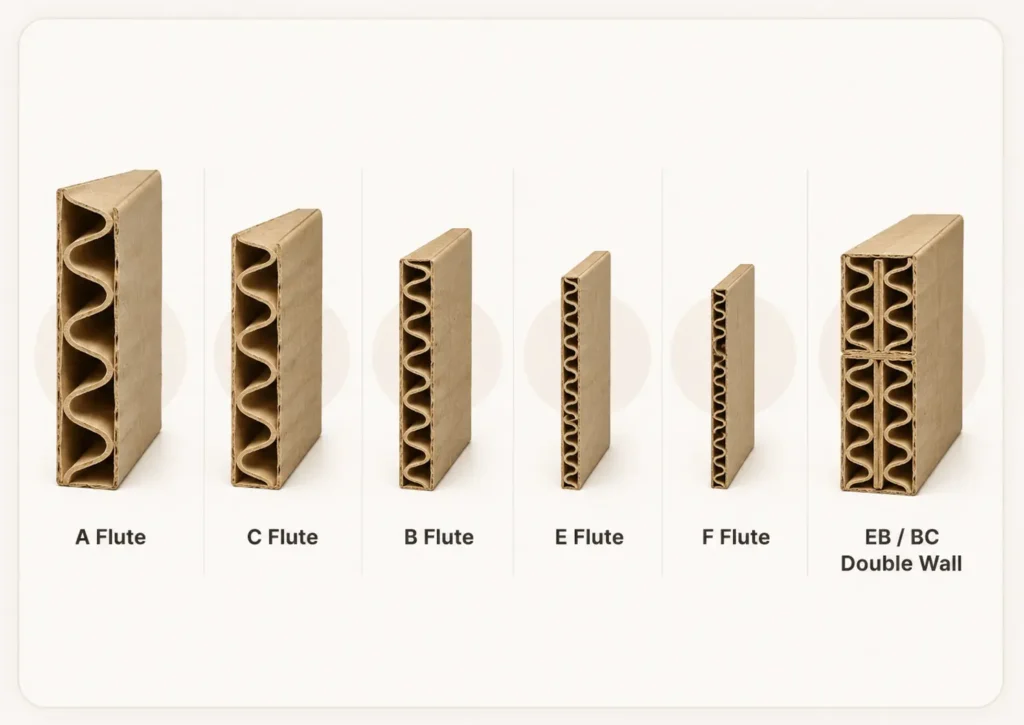
E and B flute cover many printed mailer box applications, C flute is a practical general-shipping starting point, A flute prioritizes cushioning, and double wall addresses higher structural risk. The following heights exclude the liners: FEFCO lists about 4.8 mm for A, 3.6 mm for C, 2.4 mm for B, 1.2 mm for E and 0.5–0.8 mm for microflutes.
A Flute
A thick corrugated profile designed primarily for cushioning, board thickness and protection against impact.
Strong cushioning and greater overall board thickness.
Fragile products, industrial parts and impact-sensitive goods.
Requires more space and provides a rougher printing surface.
Choose A flute when cushioning matters more than compactness or refined printing.
C Flute
A general-purpose flute balancing cushioning, compression strength and shipping performance.
Balanced cushioning and dependable shipping performance.
General shipping cartons and secondary packaging.
Thicker than B or E flute for storage and fulfillment.
Use C flute when general shipping protection is more important than a compact profile.
B Flute
A versatile option combining good crush resistance with a relatively smooth printing and converting surface.
Good crush resistance with a smoother surface than thicker flute profiles.
Mailer boxes, die-cut boxes, displays and ecommerce packaging.
Less cushioning than A or C flute for highly fragile goods.
B flute is often a practical starting point when a mailer box needs strength without becoming excessively thick.
E Flute
A thin corrugated profile commonly selected for lightweight branded mailers and retail packaging.
Compact profile and a clean surface for printed graphics.
Apparel, accessories, cosmetics and lightweight ecommerce goods.
Limited cushioning and stacking strength for heavier products.
E flute works well when appearance and shipping efficiency matter, but product weight must still be checked.
F Flute
A very thin corrugated construction intended for compact retail packs and refined graphics.
Very thin construction with a refined printing surface.
Small retail packs and compact consumer products.
Limited cushioning and reduced material availability.
Confirm material availability and shipping requirements before selecting F flute.
EB or BC Double Wall
Two corrugated flute layers combined for greater strength and protection during demanding shipping conditions.
Greater structural strength and resistance to handling damage.
Heavy products, fragile goods, export cartons and long-distance shipping.
Higher material cost, weight and shipping volume.
Select double wall according to product weight, stacking pressure and shipping risk.
Not sure which flute profile fits your packaging?
Tell us what you are packing and whether the box is for retail, ecommerce or export. We can shortlist suitable flute options before detailed specifications are confirmed.
E Flute vs B Flute: Which Is Better for Custom Mailer Boxes?
For lightweight branded mailers, E flute is usually the more compact and printable starting point. Choose B flute when a larger box, concentrated weight or courier handling requires more rigidity. Neither is automatically correct: product fit, empty space, inserts and the complete board grade still affect performance.
Choose E for crisp folds and compact storage. Choose B for greater rigidity. For glass, liquids or concentrated weight, also evaluate the insert and complete board grade. Litho lamination improves graphics but adds material, processing and cost.
Not Sure Between E Flute and B Flute?
Share your product photo, dimensions and packed weight. We can compare E flute and B flute based on rigidity, print quality and mailer storage efficiency.
No final box size or dieline required.
Recommended Flute by Mailer Box Application
The best flute for a mailer box depends on how weight is distributed and how easily the product can move or break. Use these recommendations as sampling starting points rather than universal guarantees.
| Mailer box application | Starting recommendation | Why |
|---|---|---|
| Apparel and soft goods | E flute | Lightweight, compact and printable |
| Cosmetics without glass | E or B flute | Depends on combined weight and box size |
| Glass bottles | B flute with a fitted insert | Adds rigidity while controlling product movement |
| Subscription kits | E or B flute | Depends on total weight, layout and empty space |
| Heavy ecommerce products | B or EB double wall | Provides a stronger starting structure for handling pressure |
Swipe horizontally to view the full table.
Compare physical E- and B-flute samples when print, folding and protection all matter. Originality Pack can prepare custom ecommerce packaging boxes around the actual packed dimensions.
When Should You Choose EB or BC Double-Wall Corrugated Board?

Choose double-wall board when product weight, large panel dimensions, stacking or repeated handling makes a single-wall structure too risky. Do not specify EB or BC simply because it sounds more protective: double wall adds board weight, storage volume, material cost and folding resistance.
EB suits branded packs needing added rigidity; BC is more common for heavy products or demanding shipping. Double wall suits fragile sets, large cartons and export handling, but is usually unnecessary for lightweight goods when single wall passes the required checks.
Why Flute Type Alone Does Not Determine Box Strength
Flute type alone cannot determine box strength because paper grade, board construction, flute direction, box dimensions and test values also affect performance. FEFCO reports typical ranges of 90–200 gsm for liner and 90–150 gsm for fluting, so two E-flute boards can perform differently.
A factory should also review product size and weight distribution, fragility, internal fit, inserts, box style, flute direction, paper specifications, required test values, stacking and transport conditions.
Packaging Corporation of America explains that arches resist pressure across the board and flute columns resist vertical crush forces. Flute direction and box construction therefore affect performance. Buyers can also compare different custom paper box structures.
How Factory Experience Informs a Flute Recommendation
Based on 25+ years of custom packaging production, Originality Pack starts many lightweight apparel mailers with E flute, then evaluates B flute or double wall as size, concentrated weight, glass or export handling increases risk. The factory produces E- and B-flute mailers and supports sampling, size review and insert planning. Confirm exact double-wall construction per project.
Two Practical Flute Selection Examples
These examples show how product fit, fragility and shipping conditions can change the starting flute recommendation.
Lightweight Apparel Mailer
A lightweight garment set usually does not need B flute simply for added thickness. If the box is oversized, E flute with a closer internal fit can reduce material and storage volume while still providing clean folding and suitable protection for normal ecommerce delivery. Our guide to mailer box packaging for e-commerce brands covers what to check before placing this kind of order.
Glass Skincare Set
How to Choose Corrugated Flute in Five Practical Steps
Start with the packed product, then evaluate distribution and presentation before comparing samples.
- Define the product: weight, dimensions, fragility and movement.
- Define the route: retail, courier, pallet or export.
- Set the visual requirement: print method, coverage and finish.
- Compare samples: especially physical E- and B-flute options.
- Test the pack: fit, corners, closure and stacking.
Factory Recommendation:Before reducing flute size, correct an oversized box. Closer fit or a better insert may reduce movement and board area without reducing protection.
Common Mistakes Brands Make When Specifying Corrugated Flute
The most expensive flute mistakes come from treating thickness as a complete specification, ignoring product movement and approving the structure without a physical pack test.
Assuming thicker always means stronger
A thicker flute does not automatically create a stronger box. Weak paper grades, incorrect flute direction or an oversized structure can still lead to poor performance.
Providing weight without dimensions
Product weight alone cannot determine the right flute. Panel size, box depth and structure directly affect bending, stacking and compression behavior.
Choosing E flute only for printing
E flute provides a smoother surface, but appearance should not be the only consideration. Heavy or fragile products may require additional protection.
Ignoring empty space inside the box
Excess internal space allows products to move during shipping and may increase material usage without improving protection.
Learn how to choose the right mailer box size →
Approving only a digital mockup
A screen preview cannot verify stiffness, folding behavior, closure tension or actual protection performance.
What Should You Send Your Supplier for a Reliable Flute Recommendation?
A supplier can recommend a starting flute without a finished dieline, but needs enough information to understand the load and route. At minimum, provide dimensions, packed weight, a product photo, quantity and delivery country. If you’re packaging apparel specifically, our clothing packaging quote checklist lists everything a supplier typically needs before quoting.
- Product photo, packed weight and dimensions
- Quantity, use case and delivery country
- Fragility, liquids, sharp edges and stacking needs
- Artwork, printing and finish requirements
- Need for an insert or outer shipping carton
Factory Note: A supplier can propose a starting structure from a partial brief, but recheck the sample after final dimensions and packing are confirmed.
Originality Pack can compare E flute, B flute and stronger structures while accounting for printing, inserts and flat-pack delivery. If your specifications are incomplete, use our packaging quote and structure review so missing decisions can be identified before sampling.
Frequently Asked Questions About Corrugated Flute Types
Start with E flute for lightweight printed packs and B flute for larger mailers needing more rigidity. Confirm against fit, weight, fragility and shipping.
B is thicker and may be more rigid, but paper grade, box design, direction and test values also determine strength.
Evaluate it for heavy, fragile, large or demanding shipments—not when single wall already meets the requirement.
Yes, when fit, folding, closure or protection is uncertain. A physical sample reveals what a mockup cannot.
Choose the Flute That Matches the Packaging Job
E suits lightweight branded mailers, B adds rigidity, C balances shipping needs, A prioritizes cushioning, and double wall serves demanding applications. Always consider the complete board and box design.
Define the packed product and distribution route, compare realistic structures, and approve the box with its actual contents. This avoids both damaging under-packaging and wasteful over-packaging.
Ready to Validate Your Corrugated Box Structure?
Share your packaging brief, artwork status, estimated quantity and delivery destination. We can turn the selected flute into a practical box structure, insert recommendation and sampling plan.
No final dieline or box specification required.