
Quick Answer
The right type of mailer box insert depends on product weight, fragility, shape, presentation, quantity, and shipping conditions.
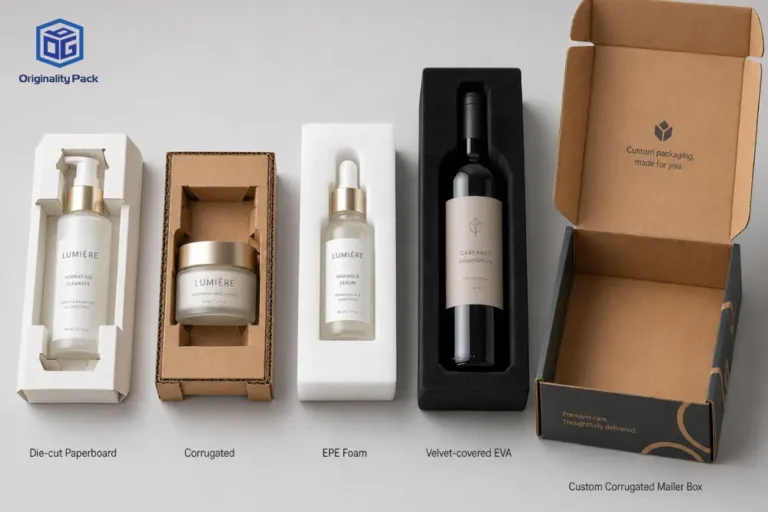
Die-cut paperboard and corrugated inserts are used most often because they control movement without adding excessive volume. EPE (expanded polyethylene) and EVA (ethylene-vinyl acetate) add cushioning but cost more, occupy more space, and are more commonly paired with rigid gift boxes.
A mailer box protects the shipment; its insert controls movement. Custom box inserts for shipping should protect the product without unnecessarily increasing the outer mailer size, tooling cost, or packing time.
Table of Contents
What Does a Mailer Box Insert Actually Need to Do?
An insert may position, separate, support, cushion, or present a product, but no material does everything equally. Identify the main risk: movement, impact, contact, weight, scratching, or presentation.
Unlike promotional insert cards, shipping box inserts are structural components designed to position and protect products. A project may include both a protective insert and a custom printed insert card.
Which Mailer Box Insert Fits Your Product?
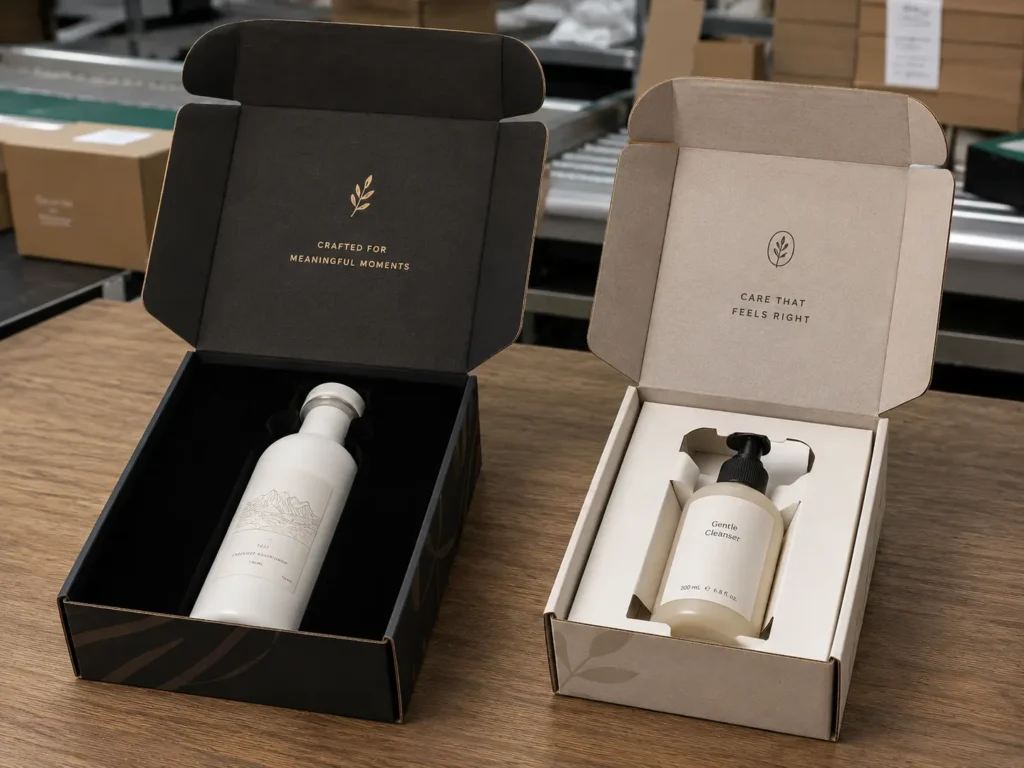
Start with product risk, then compare appearance, order volume, tooling, and packing speed. Paper structures suit positioning and separation; foam suits higher shock risk; molded options require stable dimensions and volume.
Compare Mailer Box Insert Types
Select an insert material to compare its protection, cost, box pairing, packaging volume, and main limitations.
EPE Foam Insert
Protection focusedGlass products, bottles, appliances, and other fragile items.
Provides lightweight cushioning with a practical, functional appearance.
Usually more affordable than EVA, depending on density, thickness, cutting, and quantity.
Protective corrugated mailer boxes or rigid gift boxes.
High. EPE does not ship flat and may require a larger outer box.
Less precise and presentation-focused than EVA.
EVA Insert
Premium positioningWine, spirits, electronics, jewelry, and premium gift sets.
Firm positioning, accurate cutouts, and a clean presentation.
Higher cost. Density, thickness, cutout complexity, and surface covering affect the final price.
Most commonly used in rigid gift boxes and selected premium mailers.
High. Thick EVA can enlarge the finished packaging system.
Unnecessary material cost for lightweight or low-risk products.
Die-Cut Paperboard Insert
Most flexible optionCosmetics, accessories, stationery, and primary-packed products.
Good positioning and printable presentation, but limited impact cushioning.
Flexible for smaller runs, product launches, and design changes.
Corrugated mailer boxes and folding cartons.
Low. Folded paperboard structures use storage and shipping space efficiently.
Limited cushioning and load support for heavy or highly fragile products.
Corrugated Insert
Structural supportHeavier items, bottles, jars, candles, and multi-product sets.
Better structural and compression support with a practical appearance.
Generally more accessible than molded structures and suitable for customized layouts.
Corrugated mailer boxes and conventional shipping boxes.
Low to medium, depending on flute thickness and structural complexity.
Uses more internal space than thin paperboard inserts.
Molded Pulp Insert
Stable repeat programsProducts with stable dimensions and predictable repeat-order volumes.
Provides contoured support with a natural fiber-based appearance.
Requires tooling and normally needs a higher MOQ to justify setup costs.
Rigid boxes and higher-volume corrugated mailer programs.
Medium to high because formed pulp trays do not ship flat.
Poor fit for launch-stage products or frequent dimension changes.
Thermoformed Tray
High-volume precisionHigh-volume products with stable dimensions and a fixed packing orientation.
Accurate, repeatable cavities with efficient packing and presentation.
Requires tooling and normally needs a high MOQ to distribute setup costs.
Rigid boxes and standardized high-volume retail packaging.
Medium to high because formed trays retain their shape during storage.
Uses plastic and offers limited tolerance for future product changes.
Factory Perspective: Die-cut paperboard and corrugated inserts are used more frequently in mailer boxes because they control movement without adding excessive material cost or packaging volume. EPE and EVA provide additional cushioning, but they cost more and occupy more space. Once a mailer requires a thick foam insert, much of its freight advantage may be lost. For gift-oriented projects, brands often choose a rigid gift box instead.
Mailer Box + Insert Planning
Not Sure Which Insert Fits Your Product?
Send us a few basic product details. Our team will compare one or two practical insert structures together with the outer mailer box, rather than recommending the insert separately.
What you can send us:
- ✓ Product photos
- ✓ Approximate dimensions
- ✓ Filled product weight
- ✓ Order quantity
- ✓ Delivery country
No Final Dieline Required
Get a Practical Insert Recommendation
We will review product fit, protection, box size, material use, and packaging volume before suggesting a structure.
Get an Insert Recommendation →Why Are EVA and EPE Used More Often in Rigid Gift Boxes?
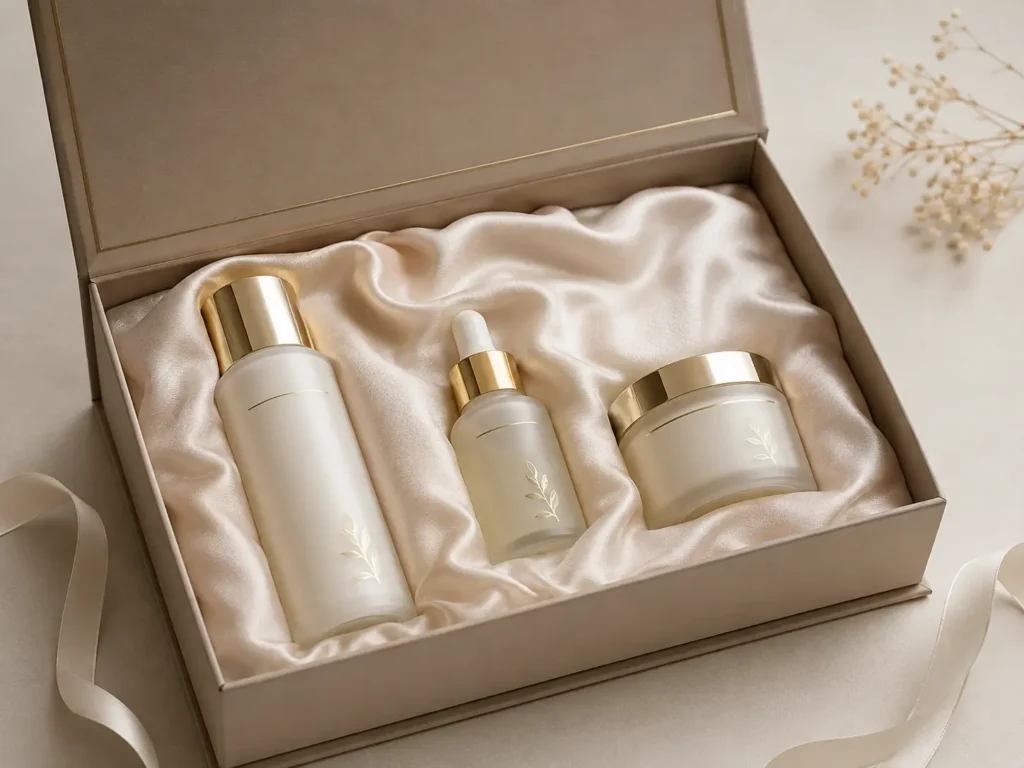
EPE and EVA are more common in rigid gift boxes because their cushioning and presentation can justify the higher material cost and packing volume. EPE, commonly called pearl cotton, is lightweight, resilient, and usually less expensive than EVA. EVA provides cleaner, more accurate cavities.
Wine and spirits, jewelry, electronics, precision products, and gift sets may benefit from EVA support and optional velvet, silk, fabric, or paper covering. These products are also more likely to use a rigid gift box because the buyer is already paying for a presentation-led structure.
Using thick EPE or EVA in a mailer is still reasonable when cushioning is essential, but it should be treated as a protection-driven exception. The foam cost and non-flat volume can reduce the freight and storage advantages that made the mailer attractive in the first place.
If you are still deciding between a mailer box and a rigid gift box for your product, see our mailer box vs rigid box vs poly mailer comparison.
When Should You Choose Paperboard or Corrugated Inserts?
Use die-cut paperboard or corrugated inserts when the main job is to stop products from sliding, rotating, or touching each other. Corrugated structures can also carry more weight and resist compression, but neither material cushions impact like EPE or EVA.
Paperboard works for skincare cartons, accessories, stationery, and primary-packed products. Printing and lamination add cost and affect material composition.
Corrugated platforms, end supports, dividers, and partitions add compression resistance for bottles, candles, jars, and sets, but flute thickness consumes space.
For candle jars, coordinate the insert with the outer box using this candle packaging guide before sampling.
For heavier products, coordinate the insert with the corrugated mailer box rather than increasing insert thickness independently. A stronger insert cannot compensate for an outer box that collapses or opens during handling.
When Are Molded Pulp and Thermoformed Trays Worth a Higher MOQ?
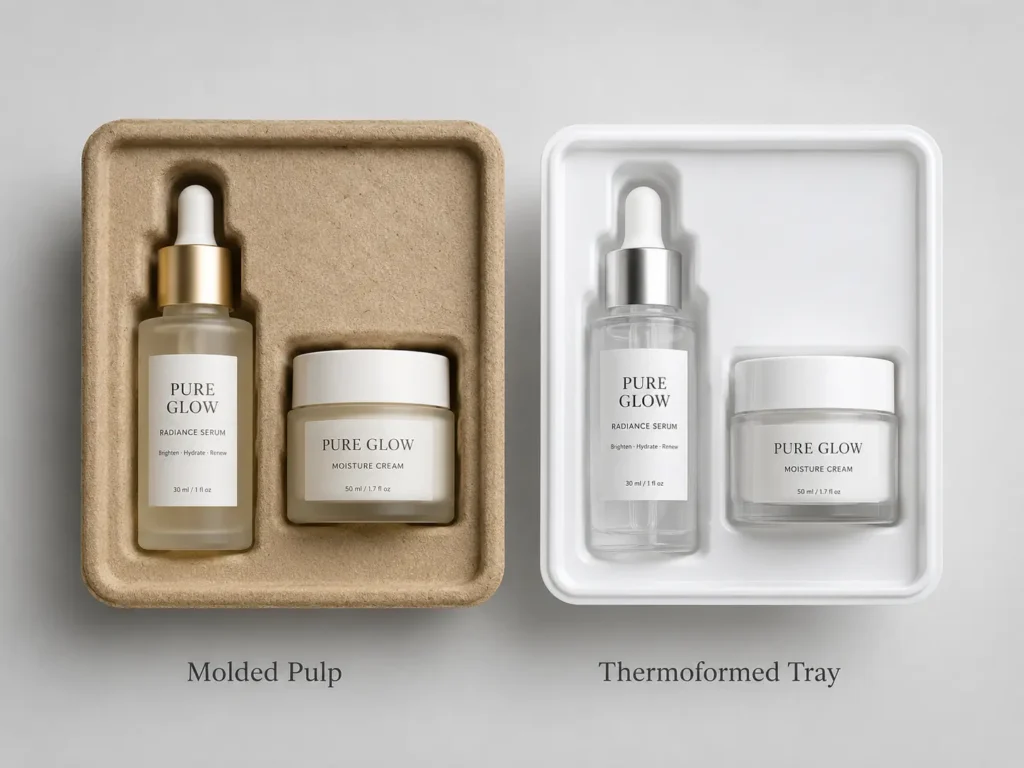
Molded pulp and thermoformed trays are most suitable when the product dimensions, packing orientation, and repeat order volume are stable enough to justify tooling. Both create shaped cavities, but changing the product later may require modifying or replacing the mold.
Molded pulp provides a formed fiber structure with moderate support. Tooling, drying, trimming, surface quality, and quantity affect feasibility, making it a poor choice for launch-stage SKUs likely to change.
Thermoformed plastic trays provide accurate, repeatable cavities and faster packing in stable high-volume programs. They add plastic to the mailer system and do not cushion like EPE or EVA.
Molded fibre may be compatible with paper recycling streams, but actual recyclability depends on coatings, adhesives, contamination, collection systems, and local requirements. The FEFCO Corrugated Packaging Recyclability Guidelines likewise treat composition and packaging design as part of recyclability assessment.
Is Fabric, Silk, Velvet, or Paperboard a Separate Insert Type?
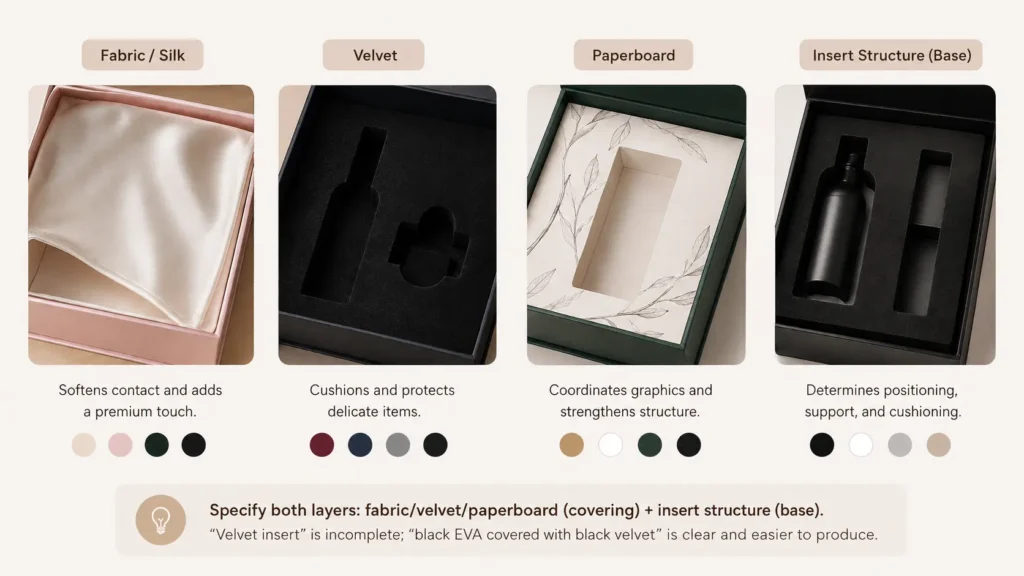
Fabric, silk, velvet, and decorative paperboard are coverings, not supporting insert structures. The EVA, EPE, paperboard, or rigid base underneath determines positioning, support, and cushioning.
Velvet or silk can soften contact for jewelry or wine gifts; fabric may reduce scuffing; printed paperboard coordinates graphics. Each adds material, gluing, assembly, and quality control.
Specify both layers. “Velvet insert” is incomplete; “black EVA covered with black velvet” is easier to price, sample, and approve.
How Do Inserts Change Box Size, Packing Speed, and Shipping Cost?
An insert should be designed inside the final mailer dimensions because extra thickness can increase material use, packing labor, storage volume, and dimensional shipping weight. A thicker insert may improve support, but it can also force the factory to enlarge the box.
Carriers may use dimensional weight when a package is large relative to its actual weight. The UPS shipping dimensions and weight guide uses package length, width, and height in the calculation, making unused space a commercial issue.
An insert requiring several folds or precise alignment may slow fulfillment. Test the complete packing sequence with the product, accessories, tissue, cards, and box closure.
For a full walkthrough of measuring internal vs external mailer box dimensions and adding clearance for inserts, see our custom mailer box sizing guide.
What Should You Check Before Approving a Mailer Box Insert Sample?
Approve the insert with real production products, not only drawings or an empty sample. Product batches can vary, and pumps, caps, labels, seams, bottle shoulders, or assembled parts may create dimensions that are not visible in the basic specification.
- Fit: Test several product units, not only one ideal sample.
- Load points: Make sure the insert supports strong areas rather than caps, hinges, glass edges, or decorative parts.
- Movement: Close the complete box and check sliding, rotation, and product-to-product contact.
- Removal: Confirm that the customer can lift the product out without forcing it.
- Box closure: Ensure the insert does not push against the lid or distort the mailer walls.
- Packing sequence: Time how long it takes to assemble the insert and pack every component.
- Shipping test: Choose a test method appropriate to the product value, fragility, route, and sales channel.
Factory-experience benchmark: Samples typically take around 10 days, while mass production usually takes 15–20 days after approval. Molded tooling, surface coverings, and multi-component testing may require additional time.
Which Common Insert Mistakes Create Rework or Product Risk?
- Using incomplete measurements. Ignoring a pump, closure, label seam, or protective bag can make the cavity too tight.
- Choosing by appearance alone. Velvet-covered EVA may be unnecessary for basic cushioning, while thin paperboard cannot be expected to absorb impact for heavy glass.
- Finalizing the insert before the box. Changes to depth, flute, or closure geometry can force insert rework.
- Ignoring MOQ before molding. Molded pulp and thermoformed trays generally have high MOQs because tooling and setup must be distributed across the order.
- Specifying only the surface. “Silk insert” or “velvet insert” omits the supporting material and can produce inconsistent quotes.
Why Should the Mailer Box and Insert Be Planned as One System?
Planning the box and insert together reduces fit changes, duplicate sampling, and shipping-volume surprises. A factory can compare dimensions, weight, assembly, mailer strength, and carton packing before approval.
Originality Pack can review all six insert directions with the outer mailer. Materials, MOQ, tooling, surfaces, and protection require project-specific confirmation.
FAQ: What Should Buyers Confirm Before Ordering Custom Mailer Box Inserts?
Choose the Simplest Insert That Controls the Real Risk
Choose paperboard or corrugated board for efficient movement control, EPE or EVA when cushioning justifies extra volume, and molded options only when stable dimensions and volume justify tooling.
Plan the Insert Before the Outer Box
Get an Insert Recommendation Before You Finalize the Box
Originality Pack can compare one or two practical insert structures together with the outer mailer, helping you evaluate product fit, protection, packaging volume, and final box dimensions before production.
No Final Dieline Required
Start With the Product Details
A confirmed box size is not required. Send the information you already have and receive a practical insert direction within 24 hours.
Get an Insert Recommendation →Sources Used
- FEFCO: Corrugated Packaging Recyclability Guidelines—Design for Circularity
- UPS: Shipping Dimensions and Weight
- Technical review: Originality Pack Packaging Team, based on material selection, sampling, and production experience with custom mailer boxes and inserts.
- Factory-experience judgments in this article: Paperboard and corrugated inserts are used more frequently in mailer boxes to control movement while preserving packing-volume efficiency; EPE generally costs less than EVA; EPE and EVA add cushioning but are more common in rigid gift boxes because their cost and non-flat volume can reduce a mailer box's freight advantage; fabric, silk, velvet, and paperboard can be coverings rather than structural bases; molded pulp and thermoformed trays normally require higher MOQs.
- External-source judgments: FEFCO supports the recyclability-design discussion; UPS supports the dimensional-weight discussion. Both sources are linked inline where the claims appear.