
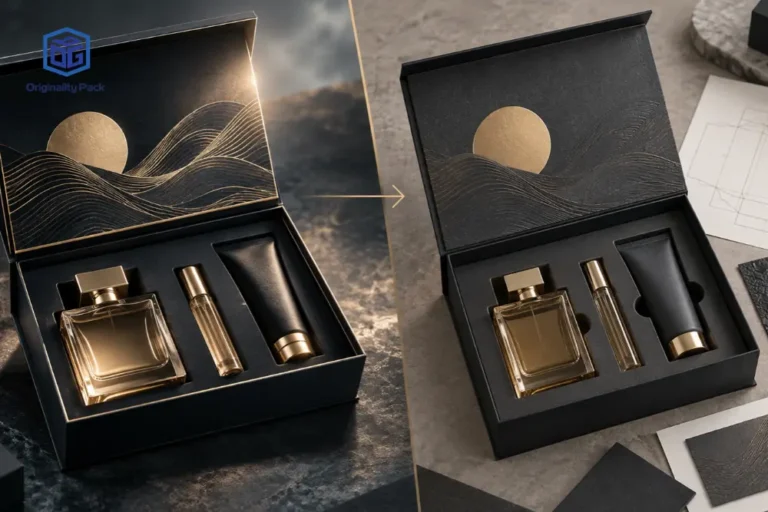
Quick Answer
Yes, many AI-generated packaging concepts can be manufactured, but the image itself is not a production specification. A gift box manufacturer must confirm the structure, dimensions, available materials, finishes, artwork, and insert fit. Rendered textures or reflections may need different materials or processes to become practical. Agree on those changes using real material and finishing references, structural verification, and samples appropriate to the details being approved before production begins.
Already have a concept? Tell us about your AI gift box design.
You have an AI image of the gift box you want: the right colors, a striking gold logo, an unusual surface, and products arranged neatly inside. The next question is practical: what would a factory actually deliver?
Start by identifying the details you want to keep, then review the changes needed to manufacture the box. The examples below use an illustrative retail perfume gift set with a gold logo, textured-looking wrap, and fitted insert.
Can AI-Generated Gift Box Designs Be Manufactured?
Many concepts can be developed into real boxes after their individual features are reviewed. Different parts of the same image can need different answers: a familiar box shape may be practical, while its pictured texture needs replacing and its insert still needs product measurements.
At OriginalityPack, our sales team typically begins by identifying details that cannot be achieved and details that can be produced with differences. We show customers actual effects and previous work, offer similar material options, and recommend inserts around the real product.
Expect one of three review outcomes:
- Cannot be made as shown: Ask which detail causes the problem and what would need to change. Decide whether that detail is essential.
- Can be made with a different appearance: Compare actual material or finishing references and agree on the acceptable result.
- Needs further verification: Provide the missing product information and identify what a structural drawing or sample must check.
Factory Feasibility Check: What Can Be Reproduced from an AI Packaging Design?
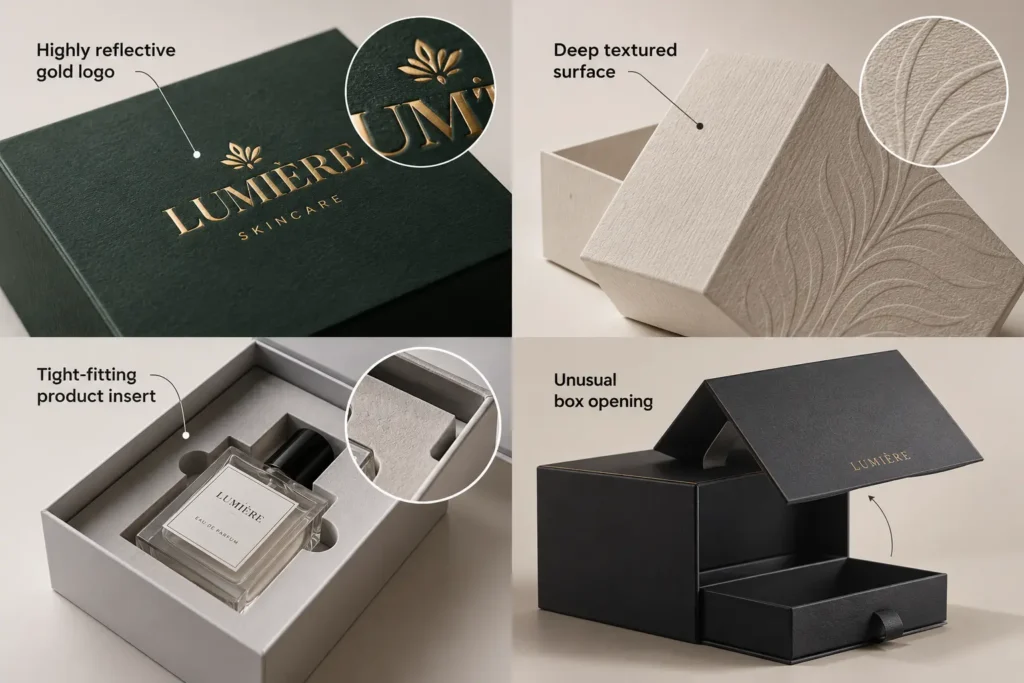
These are potential manufacturing approaches. Their suitability and availability must be confirmed for the project; technical possibility does not establish that a particular factory can supply every option.
| AI Design Feature | Practical Manufacturing Approach | What Needs Verification |
|---|---|---|
| Highly reflective gold logo | Consider a metallic foil with a suitable gloss level and a defined stamping area. | Selected foil and paper, compatibility, logo detail, and actual appearance. The rendered lighting does not specify a reproducible finish. |
| Deep textured surface | Compare textured specialty paper, a separately embossed effect, or a printed texture pattern. These achieve different physical results. | Available material, actual relief and touch, forming or wrapping suitability, and compatibility with printing or finishing. |
| Tight-fitting product insert | Develop the support and cutouts around the actual product and how it will be packed and removed. | Final dimensions, filled weight, fragile areas, movement, removal access, and lid clearance with all contents loaded. |
| Unusual box opening | Identify a workable lid-and-base, hinged, drawer, or other proposed construction before developing artwork. | Opening action, clearances, assembly method, and whether the filled box closes and operates as intended. |
Swipe horizontally to view the full table.
If the opening is unclear, name the intended mechanism first. A separate lid, a hinged magnetic cover, and a sliding drawer require different constructions. Our rigid box style comparison can help you describe which one you want.
Need to Compare Your Concept with Practical Options?
- Tell us which pictured details matter most and what the box will hold.
Our team can help identify practical structures, material and finish options, and points that need confirmation before sampling or production.
Why Might Real Foil Stamping Look Different from the AI Image?
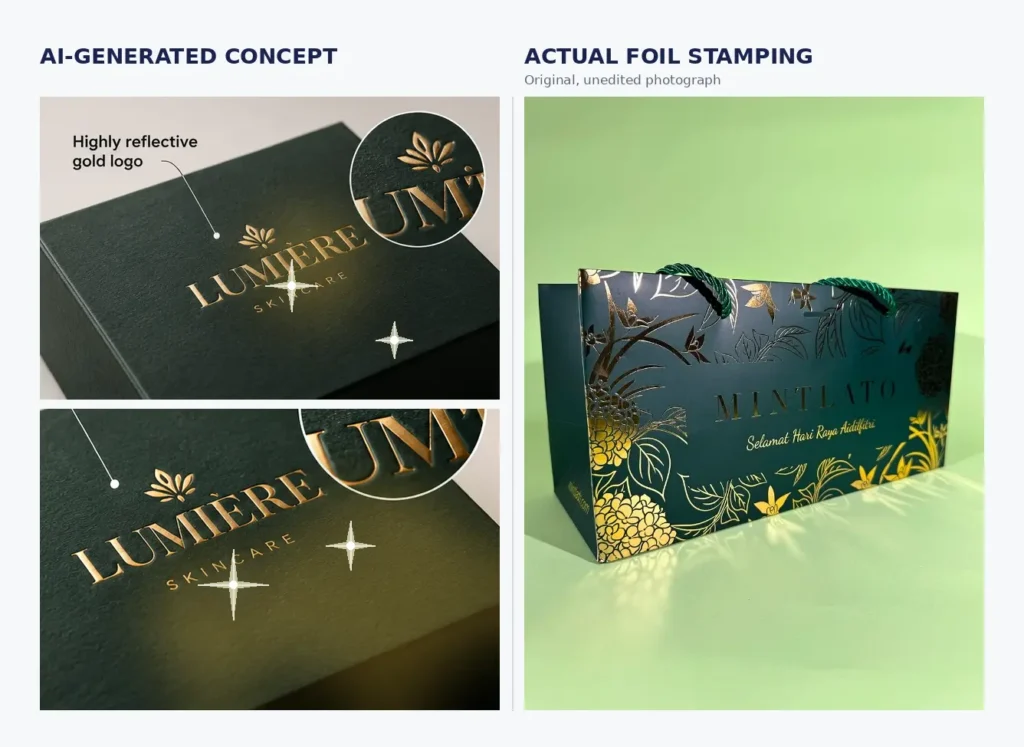
Real foil can create a highly reflective finish, but an AI image cannot establish the selected foil, paper, or result under different viewing conditions. An intensely bright gold logo needs an actual finishing reference before you approve its appearance.
KURZ’s hot-stamping guidance describes different metallic effects and gloss levels, and explains that the substrate surface affects stamping adjustments. “Gold” alone leaves important choices unresolved.
When an AI image creates an unrealistic expectation of the finished effect, we show the customer what actual foil stamping looks like. The comparison gives the buyer something concrete to accept or change.
When reviewing a reference, ask:
- Is this the proposed foil, or only an example of a similar appearance?
- Is it shown on the selected paper, or on a different surface?
- Can I see the effect from another angle, rather than judging it from one bright reflection?
- Which areas of my design will receive this finish?
A useful instruction is: “Keep the gold logo, but show me the proposed foil on the selected paper before I approve the appearance.” If the reflective effect is central to your design, ask whether a physical reference or project-specific finish sample is appropriate.
What If the Material in Your AI Design Is Unavailable?
A rendered surface does not identify a purchasable material. When we cannot find a material matching the pictured effect, we offer similar options for the customer to compare. First establish which visual or tactile qualities should take priority.
For example, an image may suggest a deep texture, a very smooth reflection, and a particular color at once. Explain which of those qualities matters most to your brand before looking for substitutes.
Distinguish the Paper Surface from an Added Effect
Textured specialty paper can supply a physical surface pattern. Fedrigoni's Mistral Tradition specification, for example, identifies an embossed paper texture.
A separate embossing operation creates physical relief through tooling;
a printed texture pattern provides a graphic appearance and does not by itself establish tactile depth.
Ask which route is proposed and check an actual reference. This distinction does not imply that a named paper is stocked or suitable for your order.
How to Choose Between Similar Material Options
| Your Priority | What to Compare | What to Decide |
|---|---|---|
| Texture and touch | Actual samples of the available textured materials. | Whether their color and sheen are acceptable alongside the texture. |
| Color direction | Available papers or printed finishes against an agreed color reference. | How much variation in texture or surface appearance you can accept. |
| Sheen or metallic appearance | Actual surface and finishing options, identified by material and process. | Whether their appearance and feel preserve what you liked about the image. |
Swipe horizontally to view the full table.
The available combinations still need checking for your project. A photograph can help you shortlist a look, but it cannot let you feel the surface.
Record the chosen compromise explicitly: “Keep the textured appearance; accept the selected paper’s different sheen.” This gives both sides a clearer target than asking for the “closest match” without defining what should stay closest.
Will the AI-Designed Insert Work with Your Actual Product?
An insert must fit and support the real product while allowing packing and removal. A neat arrangement in an AI image does not establish those requirements.
We frequently need to reconsider pictured inserts and recommend a suitable option using the customer’s actual product. Provide dimensions and filled weight, the number of items, and details such as caps, pumps, fragile parts, or surfaces that should avoid rubbing. A physical product is useful for final fit checks; establish what will be used for that verification.
During sample review, load the intended contents and check the full sequence:
- packing,
- closing,
- opening,
- and removing each item.
Can the customer grip the product? Does the insert interfere with the lid? Are accessories still accessible?
Illustrative example: A perfume gift-set image shows a bottle sitting flush in a tight opening. A practical proposal might need access around the bottle so the customer can lift it out. Review that change together with the final cap, bottle dimensions, and box height; the image cannot settle those details.
Do not estimate usable internal dimensions from the picture’s perspective. Confirm the space remaining after the structure and insert are chosen. If the box will be shipped, product fit and transport protection also require separate review.
How Do You Turn an AI Packaging Mockup into Production Specifications?
Agree on the structure, material references, artwork, finish areas, and product fit separately. Record accepted differences from the AI image so the production target is clear.
Production artwork must correspond to the chosen construction and dimensions. For a wrapped rigid box, the printed wrap and component layouts need to suit that construction. A generic carton template cannot establish those requirements.
Esko’s packaging prepress overview explains checks including artwork alignment with dielines, image resolution, fonts, and color preparation. An AI illustration may become part of the artwork, but the complete packaging file still needs review for the intended process.
Bleed also needs to be set for the manufacturer’s layout. Adobe explains bleed as artwork extending beyond the trim boundary to accommodate trimming. Use the project requirements rather than assuming one universal setting. Our packaging artwork guidelines explain how to start a file review or request a project template.
What Each Production Reference Can and Cannot Confirm
| Reference | Useful For | Still Needs Separate Confirmation |
|---|---|---|
| AI concept image | Overall direction, preferred features, and design priorities. | Actual construction, material identity, finish, and fit. |
| Previous production example | Understanding an actual material, finish, or construction used before. | Whether it suits the new design, dimensions, and product. |
| Selected material or finish reference | The specific surface or finishing direction being considered. | Its suitability and appearance in the proposed combination. |
| Reviewed artwork | Approved wording, logo placement, panels, and marked finish areas. | Physical feel, product fit, and effects not represented by that proof. |
| Project sample | The attributes actually represented by its materials and making method. | Any omitted processes, approximate effects, or untested requirements. |
Swipe horizontally to view the full table.
A previous project helps explain a finish; it does not automatically establish the result on a different paper. Likewise, a structural sample can help check fit without representing the final print or foil. Agree what the sample will prove before commissioning it. Our packaging sample approval checklist covers how to record its scope.
Keep the selected references, accepted differences, and latest artwork together. If a material, finish, structure, or product changes, review the affected decisions again before production approval.
What Should You Confirm About MOQ, Sampling, and Lead Time?
Our Luxury Paper Box product page currently lists a starting MOQ of 100 pieces, sample availability in 5–7 days, and a lead-time reference of 10–20 days. These are product-page planning references; confirm applicability to your quantity, structure, materials, and finishes.
Before accepting a quotation, clarify the sample scope and charges, required approvals, and delivery basis. Confirm when the quoted lead time starts and whether sampling and transit are included. A concept review can begin early, but final pricing and a production schedule require the necessary specifications to be agreed.
What Should You Send with Your AI Gift Box Reference?
You can start with an AI reference even if your final dieline or production artwork is not ready. Mark which details must stay and which are open to alternatives. If dimensions or product choices are provisional, say so; quotation, sampling, and production will still require the relevant specifications to be confirmed.
Use this short message to start the discussion:
Build Your Packaging Inquiry
Enter your project details below. Your inquiry will update automatically and be ready to send.
Your Inquiry Preview
Updates automatically as you typeWe have an AI reference for a gift box for . The product measures [dimensions, with units] and weighs [filled weight]. We need [quantity] boxes delivered to [country/postal code] by [target date]. Please keep [priority details]; we are open to changing [flexible details]. Could you identify what cannot be made as shown, show actual material and finishing options, and recommend an insert? We currently have [logo/artwork files or no final artwork]. Please clarify what needs confirmation before quotation and sampling.
Bring Your AI Packaging Idea to Life with the Right Factory
AI helps you visualize your packaging ideas and communicate the look you want more clearly. A reliable packaging factory helps bring that vision to life by explaining what is achievable, showing real material and finishing options, and adapting the structure and insert to your product.
Have an AI Packaging Design? Let's Check What's Possible.
Tell us about your AI reference and basic product details.
- Our team can help identify practical box structures, material and finish options, and the details that need confirmation before sampling or production.
Use the project description field to explain your concept and note that you have an AI reference to share.
Tell Us About Your Packaging Project
Share your packaging needs, and our team will recommend the right solution for your project.